
HPB-SB-3-118: Difference between revisions
No edit summary |
mNo edit summary |
||
| (3 intermediate revisions by the same user not shown) | |||
| Line 23: | Line 23: | ||
{{Style P-HPB SB. Title continued | Sortilegy. – Dr. Doddridge |3- | {{Style P-HPB SB. Title continued | Sortilegy. – Dr. Doddridge |3-116}} | ||
{{Style P-No indent|in his prayer, as the reason which chiefly weighed with him to reject the offer, that it was far beyond his forces, and chiefly because he was too young, and had no assistant. He goes on thus: “As soon as ever this address” (meaning the prayer) “was ended, I passed through a room of the house in which I lodged, where a child was reading to his mother, and the only words I heard distinctly were these. ''And as thy days'', ''so shall thy strength be.''” This singular coincidence between his own difficulty and a scriptural line, caught at random in passing hastily through a room (but observe, a line insulated from the context, and placed in high relief to his ear), shook his resolution. Accident co-operated: a promise to be fulfilled at Northampton, in a certain contingency, fell due at the instant; the doctor was detained—this detention gave time for further representations; new motives arose, old difficulties were removed, and finally the doctor saw, in all this succession of steps, the first of which, however, lay in the ''Sortes Biblicce, ''clear indications of a providential guidance. With that conviction he took up his abode at Northampton, and remained there for the next thirty one years, until he left it for his grave at Lisbon: in fact, he passed the whole of his public life at Northampton. It must be allowed, therefore, to stand upon the records of Sortilegy, that in the main direction of his life—not, indeed, as to its spirit, but as to its form and local connections—a Protestant divine of much merit, and chiefly in what regards practice, and of the class most opposed to superstition, took his determining impulse from a variety of the ''Sortes Virgiliance.''}} | {{Style P-No indent|in his prayer, as the reason which chiefly weighed with him to reject the offer, that it was far beyond his forces, and chiefly because he was too young, and had no assistant. He goes on thus: “As soon as ever this address” (meaning the prayer) “was ended, I passed through a room of the house in which I lodged, where a child was reading to his mother, and the only words I heard distinctly were these. ''And as thy days'', ''so shall thy strength be.''” This singular coincidence between his own difficulty and a scriptural line, caught at random in passing hastily through a room (but observe, a line insulated from the context, and placed in high relief to his ear), shook his resolution. Accident co-operated: a promise to be fulfilled at Northampton, in a certain contingency, fell due at the instant; the doctor was detained—this detention gave time for further representations; new motives arose, old difficulties were removed, and finally the doctor saw, in all this succession of steps, the first of which, however, lay in the ''Sortes Biblicce, ''clear indications of a providential guidance. With that conviction he took up his abode at Northampton, and remained there for the next thirty one years, until he left it for his grave at Lisbon: in fact, he passed the whole of his public life at Northampton. It must be allowed, therefore, to stand upon the records of Sortilegy, that in the main direction of his life—not, indeed, as to its spirit, but as to its form and local connections—a Protestant divine of much merit, and chiefly in what regards practice, and of the class most opposed to superstition, took his determining impulse from a variety of the ''Sortes Virgiliance.''}} | ||
| Line 49: | Line 49: | ||
}} | }} | ||
{{Style S-Small capitals |The}} opinions of the ancients as to the disposal of the soul are curious and interesting; but here their value ceases. They imagined that the soul wandered about in the air till such time as the body obtained its due funeral rites. From this notion the friends were concerned to see the funeral pile erected for their departed friends, and to have the body honorably burnt. Then the ashes of the bones were deposited in an urn, and that urn buried in the earth. When this was done the soul was admitted to pass the flood, to be transported into the elysian fields, from whence they never should return any more. | {{Style S-Small capitals |The}} opinions of the ancients as to the disposal of the soul are curious and interesting; but here their value ceases. They imagined that the soul wandered about in the air till such time as the body obtained its due funeral rites. From this notion the friends were concerned to see the funeral pile erected for their departed friends, and to have the body honorably burnt. Then the ashes of the bones were deposited in an urn, and that urn buried in the earth. When this was done the soul was admitted to pass the flood, to be transported into the elysian fields, from whence they never should return any more. But in case these rites were not performed for any person, the soul wandered restless and unfixed, in a state of perplexity, for one hundred years. | ||
Now between this time, or during this interval—that is to say, between death and the funeral pile—they admitted the disembodied souls of men might appear, and visit their friends or harass their enemies. | Now between this time, or during this interval—that is to say, between death and the funeral pile—they admitted the disembodied souls of men might appear, and visit their friends or harass their enemies. | ||
Homer’s idea of the state of the dead was something like the ancient philosophy of the Egyptians, which gave the soul a shape like the body, and that it was only a receptacle of the mind. The mind they made to be the sublime and superior part, and that only. Thus, in the case of apparitions, they allowed that this case or shell of the soul might appear after death; but the mind could not, but was exalted among the gods, and took up its eternal abode from whence “it could return no more.” {{Style S-HPB SB. HPB note|*)}} | Homer’s idea of the state of the dead was something like the ancient philosophy of the Egyptians, which gave the soul a shape like the body, and that it was only a receptacle of the mind. The mind they made to be the sublime and superior part, and that only. Thus, in the case of apparitions, they allowed that this case or shell of the soul might appear after death; but the mind could not, but was exalted among the gods, and took up its eternal abode from whence “it could return no more.” {{Style S-HPB SB. HPB note|{{Footnote mark|*)}}}} | ||
Luther, in his “Colloquia Mensalia,” says, “When I lived at Turica, in Franconia, a child that could hardly speak or walk was got into a wood near the house. An unexpected snow covering and altering the surface of the ground, the child could not find the way back again to the house. The snow continuing to fall in great abundance, he remained there covered over with it two days and three nights. During that time an unknown man brought him meat and drink; but at the beginning of the third day, he led the child near his father's house, and there left him. I was present when he came in, and I protest he told all that had happened to him as clearly and in as good terms as I could have done myself; notwithstanding, from that time for three whole years he was not capable of putting any words together that any one could easily understand. I am, therefore, persuaded,” adds Luther, “that the man that preserved him was a good angel.” | Luther, in his “Colloquia Mensalia,” says, “When I lived at Turica, in Franconia, a child that could hardly speak or walk was got into a wood near the house. An unexpected snow covering and altering the surface of the ground, the child could not find the way back again to the house. The snow continuing to fall in great abundance, he remained there covered over with it two days and three nights. During that time an unknown man brought him meat and drink; but at the beginning of the third day, he led the child near his father's house, and there left him. I was present when he came in, and I protest he told all that had happened to him as clearly and in as good terms as I could have done myself; notwithstanding, from that time for three whole years he was not capable of putting any words together that any one could easily understand. I am, therefore, persuaded,” adds Luther, “that the man that preserved him was a good angel.” | ||
| Line 65: | Line 65: | ||
The Americans (Indians, of course) believe that all creatures have souls, not only men and women, but brutes, vegetables, nay, even the most inanimate things, as stocks and stones. They believe the same of all the works of art, as of knives, boats, looking-glasses; and that as any of these things perish their souls go into another world, which is inhabits by the ghosts of men and women. For this reason they always place by the corpse of their dead friend a bow and arrows, that he may make use of the souls of them in the other world, as he did of their wooden bodies in this. How absurd soever such an opinion as this may appear, our European philosophers have maintained several notions altogether as improbable. Some of Plato’s followers, in particular, when they talk of the world of ideas, entertain us with substances and beings no less extravagant and chimerical. Many Aristotelians have likewise spoken as unintelligibly of their substantial forms. I shall only instance Albertus Magnus, who, in his dissertation upon the load stone, observing that the fire would destroy its magnetic virtue, tells us that he took particular notice of one as it lay glowing amidst a heap of burning coals, and that he perceived a certain blue vapor to arise from it, which he believed might be the substantial form, that is, in our West-Indian phrase, the soul of the load-stone. | The Americans (Indians, of course) believe that all creatures have souls, not only men and women, but brutes, vegetables, nay, even the most inanimate things, as stocks and stones. They believe the same of all the works of art, as of knives, boats, looking-glasses; and that as any of these things perish their souls go into another world, which is inhabits by the ghosts of men and women. For this reason they always place by the corpse of their dead friend a bow and arrows, that he may make use of the souls of them in the other world, as he did of their wooden bodies in this. How absurd soever such an opinion as this may appear, our European philosophers have maintained several notions altogether as improbable. Some of Plato’s followers, in particular, when they talk of the world of ideas, entertain us with substances and beings no less extravagant and chimerical. Many Aristotelians have likewise spoken as unintelligibly of their substantial forms. I shall only instance Albertus Magnus, who, in his dissertation upon the load stone, observing that the fire would destroy its magnetic virtue, tells us that he took particular notice of one as it lay glowing amidst a heap of burning coals, and that he perceived a certain blue vapor to arise from it, which he believed might be the substantial form, that is, in our West-Indian phrase, the soul of the load-stone. | ||
{{Style S-HPB SB. HPB note| | {{Style S-HPB SB. HPB note|{{Footnote return|*)}} <u>Mind</u> is the quinte essence of the Soul and having joined its divine Spirit <u>now</u> – can return no more on earth – {{Style S-Double underline|impossible}}.}} | ||
| Line 87: | Line 87: | ||
}} | }} | ||
''To the Editor of the Spiritual Scientist:'' | {{Style P-No indent|''To the Editor of the Spiritual Scientist:''}} | ||
One of your subscribers, a person of intelligence and culture, writes to me as follows: “There is a great deal of mysticism, magic and cabala, creeping into the spiritual papers that interests me very little. If I can only get positive proof of a conscious existence after this life, I would receive it with deepest gratitude, and put off to that other life the occult studies that seem to interest so many. However, I judge no one—these students are probably hoping for something that will be of service to the world.” | One of your subscribers, a person of intelligence and culture, writes to me as follows: “There is a great deal of mysticism, magic and cabala, creeping into the spiritual papers that interests me very little. If I can only get positive proof of a conscious existence after this life, I would receive it with deepest gratitude, and put off to that other life the occult studies that seem to interest so many. However, I judge no one—these students are probably hoping for something that will be of service to the world.” | ||
| Line 96: | Line 96: | ||
= Inlay = | = Inlay = | ||
[[File:SB-03-118.1.jpg|200px|thumb|right]] | [[File:SB-03-118.1.jpg|200px|thumb|right|SB, v. 3, p. 118, inlay]] | ||
{{HPB-SB-item | {{HPB-SB-item | ||
| Line 113: | Line 113: | ||
| publication date = | | publication date = | ||
| original date = | | original date = | ||
| notes = Leaflet with archivist note | | notes = Leaflet with archivist note on this volume. | ||
| categories = | | categories = | ||
}} | }} | ||
| Line 165: | Line 165: | ||
<center>779 Broadway</center> | <center>779 Broadway</center> | ||
<center>Opposite A. T. Stewart & Co. New York</center> | <center>Opposite A. T. Stewart & Co. New York</center> | ||
<center><small> | <center><small>WEDDING AND MOURNING STATIONERY A SPECIALTY</small></center> | ||
<center><small>PUBLISHER, IMPORTER AND {{Style S-Lost|}}</small><ref>Note on left field. Ending is lost.</ref></center> | |||
<center><small>{{Style S-Lost|}} JUVENILE AND MISCELLANEOUS BOOKS.</small><ref>Note on right field. Beginning is lost.</ref></center> | |||
{{HPB-SB-footer-footnotes}} | {{HPB-SB-footer-footnotes}} | ||
Latest revision as of 08:59, 10 February 2024
 |
vol. title: vol. period: 1875-1878 pages in vol.: 277 |

< Sortilegy. – Dr. Doddridge (continued from page 3-116) >
in his prayer, as the reason which chiefly weighed with him to reject the offer, that it was far beyond his forces, and chiefly because he was too young, and had no assistant. He goes on thus: “As soon as ever this address” (meaning the prayer) “was ended, I passed through a room of the house in which I lodged, where a child was reading to his mother, and the only words I heard distinctly were these. And as thy days, so shall thy strength be.” This singular coincidence between his own difficulty and a scriptural line, caught at random in passing hastily through a room (but observe, a line insulated from the context, and placed in high relief to his ear), shook his resolution. Accident co-operated: a promise to be fulfilled at Northampton, in a certain contingency, fell due at the instant; the doctor was detained—this detention gave time for further representations; new motives arose, old difficulties were removed, and finally the doctor saw, in all this succession of steps, the first of which, however, lay in the Sortes Biblicce, clear indications of a providential guidance. With that conviction he took up his abode at Northampton, and remained there for the next thirty one years, until he left it for his grave at Lisbon: in fact, he passed the whole of his public life at Northampton. It must be allowed, therefore, to stand upon the records of Sortilegy, that in the main direction of his life—not, indeed, as to its spirit, but as to its form and local connections—a Protestant divine of much merit, and chiefly in what regards practice, and of the class most opposed to superstition, took his determining impulse from a variety of the Sortes Virgiliance.
If the reader imagines that this ancient form of the practical miraculous is at all ^one out of use, even the example of Dr. Doddridge may satisfy him to the contrary. Such an example was sure to authorize a large imitation. Hut, even apart from that, the belief is common. The records of conversion amongst felons and other ignorant persons might be cited by hundreds upon hundreds to prove that no practice is more common than that of trying the spiritual fate, and abiding by the import of any passage in the Scriptures which may first present itself to the eye. Cowper, the poet, has recorded a case of this sort, in his own experience. It is one to which all the unhappy are prone.
Opinions on Spirit Return
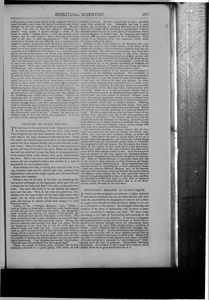
The opinions of the ancients as to the disposal of the soul are curious and interesting; but here their value ceases. They imagined that the soul wandered about in the air till such time as the body obtained its due funeral rites. From this notion the friends were concerned to see the funeral pile erected for their departed friends, and to have the body honorably burnt. Then the ashes of the bones were deposited in an urn, and that urn buried in the earth. When this was done the soul was admitted to pass the flood, to be transported into the elysian fields, from whence they never should return any more. But in case these rites were not performed for any person, the soul wandered restless and unfixed, in a state of perplexity, for one hundred years.
Now between this time, or during this interval—that is to say, between death and the funeral pile—they admitted the disembodied souls of men might appear, and visit their friends or harass their enemies.
Homer’s idea of the state of the dead was something like the ancient philosophy of the Egyptians, which gave the soul a shape like the body, and that it was only a receptacle of the mind. The mind they made to be the sublime and superior part, and that only. Thus, in the case of apparitions, they allowed that this case or shell of the soul might appear after death; but the mind could not, but was exalted among the gods, and took up its eternal abode from whence “it could return no more.” *)
Luther, in his “Colloquia Mensalia,” says, “When I lived at Turica, in Franconia, a child that could hardly speak or walk was got into a wood near the house. An unexpected snow covering and altering the surface of the ground, the child could not find the way back again to the house. The snow continuing to fall in great abundance, he remained there covered over with it two days and three nights. During that time an unknown man brought him meat and drink; but at the beginning of the third day, he led the child near his father's house, and there left him. I was present when he came in, and I protest he told all that had happened to him as clearly and in as good terms as I could have done myself; notwithstanding, from that time for three whole years he was not capable of putting any words together that any one could easily understand. I am, therefore, persuaded,” adds Luther, “that the man that preserved him was a good angel.”
Tasso, the prince of Italian poets, asserted that he was constantly attended by a good genius, with whom he had familiar converse. Socrates owned that he had a guardian angel that preserved him. Simonides had also a good genius, for, according to Valerius Maximus, he or it forced him out of a house which fell down a moment after. Valerius Maximus describes (ch. xi. 5) the ghost, or cacodaemon, which Cassius Severus, of Palma, saw. As Augustus had sent to kill him, this spirit was supposed to be a fore warner. Pliny relates of an Athenian ghost, who wandered visibly about the house rattling his chains.
Addison, in one of his papers in the Spectator (No. no), where the scene is laid in the country, at the house of Sir Roger de Cover ley, in Worcestershire, observes that they are more excusable who believe in apparitions than those who reject all extraordinary revelations of this kind, contrary to the report of all historians, sacred or profane, ancient and modern, and to the traditions of all nations, and think the appearance of spirits fabulous and groundless. Could we not give ourselves up to the general testimony of mankind, we should to the relations of persons who are living, and whom we know, and cannot distrust in other matters of fact.
The well-known opinion of Dr. Johnson on this subject is contained in the following argument: The credibility of spectral appearances has been argued on extensive grounds. We are told it is not the notion of a few individuals only— it has been the belief of all ages and nations. In every country where mankind have believed at all in a future state, and a separate existence of souls, the opinion has prevailed that the spirits of the dead may have communication with the living. There is, it is said, no people, whether rude or learned, however remote or insulated, among whom such instances have not been related or believed. Whence could arise this general agreement among nations so distant from each other, and having no intercourse, no bond of connection, but a common nature and a common destiny? Differing widely from each other in almost all other things, their testimony on this extraordinary subject has been the same. Would this notion have become universal if it were not founded in truth? Would so many nations who have never heard of one another have agreed in one tale, if fact and experience had not given it credibility? The doubts and cavils of the few cannot set aside the testimony of the many. especially as we know there is not a small number of mankind who, though they deny it with their tongues, betray plainly enough with their fears they believe it with their hearts.
The Americans (Indians, of course) believe that all creatures have souls, not only men and women, but brutes, vegetables, nay, even the most inanimate things, as stocks and stones. They believe the same of all the works of art, as of knives, boats, looking-glasses; and that as any of these things perish their souls go into another world, which is inhabits by the ghosts of men and women. For this reason they always place by the corpse of their dead friend a bow and arrows, that he may make use of the souls of them in the other world, as he did of their wooden bodies in this. How absurd soever such an opinion as this may appear, our European philosophers have maintained several notions altogether as improbable. Some of Plato’s followers, in particular, when they talk of the world of ideas, entertain us with substances and beings no less extravagant and chimerical. Many Aristotelians have likewise spoken as unintelligibly of their substantial forms. I shall only instance Albertus Magnus, who, in his dissertation upon the load stone, observing that the fire would destroy its magnetic virtue, tells us that he took particular notice of one as it lay glowing amidst a heap of burning coals, and that he perceived a certain blue vapor to arise from it, which he believed might be the substantial form, that is, in our West-Indian phrase, the soul of the load-stone.
*) Mind is the quinte essence of the Soul and having joined its divine Spirit now – can return no more on earth – impossible.
Occultism
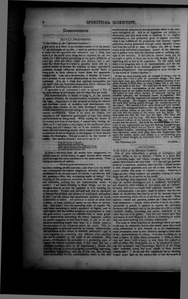
To the Editor of the Spiritual Scientist:
One of your subscribers, a person of intelligence and culture, writes to me as follows: “There is a great deal of mysticism, magic and cabala, creeping into the spiritual papers that interests me very little. If I can only get positive proof of a conscious existence after this life, I would receive it with deepest gratitude, and put off to that other life the occult studies that seem to interest so many. However, I judge no one—these students are probably hoping for something that will be of service to the world.”
The feelings thus expressed by my friend, (who is as yet only an earnest investigator, not a confirmed Spiritualist), are shared by other readers of your paper, and, as I believe, by many who have not made their opinions manifest. Like my correspondent, I am quite ready to believe that the students of occult lore, who hint to us of its marvels, hope to teach something which will be of service to the world. Their motives I would not question, neither do I deny the truth of their statements, I simply doubt whether it be of any practical benefit to people in general to receive the assurance (however well founded) that by the devotion of a life to certain <... continues on page 3-119 >
Inlay

<Untitled>
<Untitled>
Editor's notes
- ↑ image by unknown author
- ↑ Opinions on Spirit Return by unknown author, Spiritual Scientist, v. 1, No. 20, January 21, 1875, pp. 2
- ↑ Occultism by Andrews, Louisa, Spiritual Scientist, v. 3, No. 1, September 9, 1875, pp. 8-9
- ↑ notice by unknown author. Leaflet with archivist note on this volume.
- ↑ card by unknown author. Stripped card of James Miller
- ↑ Note on left field. Ending is lost.
- ↑ Note on right field. Beginning is lost.
Sources
-
Spiritual Scientist, v. 1, No. 20, January 21, 1875, pp. 2
-
Spiritual Scientist, v. 3, No. 1, September 9, 1875, pp. 8-9