
HPB-SB-7-11: Difference between revisions
mNo edit summary |
mNo edit summary |
||
| (One intermediate revision by one other user not shown) | |||
| Line 96: | Line 96: | ||
| item =2 | | item =2 | ||
| type = article | | type = article | ||
| status = | | status = proofread | ||
| continues = | | continues = | ||
| author = Olcott, H. S. | | author = Olcott, H. S. | ||
| Line 102: | Line 102: | ||
| subtitle = He Explains the Symposium of Himself and Mme. Blavatsky | | subtitle = He Explains the Symposium of Himself and Mme. Blavatsky | ||
| untitled = | | untitled = | ||
| source title =Telegram, The | | source title = Evening Telegram, The | ||
| source details = | | source details = v. 11, No. 3918, March 26, 1878, p. 3 | ||
| publication date =1878-03-26 | | publication date = 1878-03-26 | ||
| original date = 1878-03-22 | | original date = 1878-03-22 | ||
| notes = | | notes = | ||
| Line 110: | Line 110: | ||
}} | }} | ||
... | {{Style P-No indent|{{Style S-Small capitals|To the Editor of the Telegram:—}}}} | ||
I am sorry to spoil your fun at all, but, as much out regard for your own reputation as a veracious chronicler of the times as for my personal motive, I must possess you of certain facts. | |||
In au editorial of Saturday upon “Old Shep’s Ghost” you make it appear that Mme. Blavatsky and I of our own motion went hunting after the floating corpse light of the defunct night watchman in a spirit of inquiry after the supernatural. You also speak of us as “two of the principal lights of Spiritualism.” Now, neither of these assumptions are correct. We did not go to find the mystical kerosene essence, nor are we lights greater or lesser of Spiritualism. A certain individual came and begged us to go for the lark of the thing and see, not the light, but the very phantom of the submerged inebriate, which he assured us, walked its nightly rounds and frightened the neighborhood into his. He circumstantially narrated to us the pretended adventure of Officer Kilbride and the determination of the Captain of the precinct to fathom the mystery that very night. Well, sir, we listened to the voice of the siren, and as it was a beautiful moonlight went to see what to see what the police would accomplish. | |||
We found on the ground a dozen reporters, of whom one at least was equipped with fireballs to fling at the expected eidolon. Captain Murphy, of that precinct, and some subordinate officers garnered about Mrs. Blavatsky and beguiled her into a philosophical disquisition on specires, which, if the reporters had but known how to handle, might have been worked up into a capital column. I sat by and smoked. When everybody’s marrow had congealed to the point of crystallization the party dispersed and the result fully verified the prediction we made to the reporter before starting from the house, that mothing would come of the adventure. | |||
Now so far from our being lights of Spiritualism, Mme. Blavatsky and I have been carrying on a fight for some two years against the ablest champions of orthodox Spiritualism here and in England. There are two organs of this movement in this country, and one leading journal in London. It you will take the trouble to examine the files of these newspapers you will find that my learned friend and I have been abused and our views denounced in the most unsparing manner by the editors and a host of correspondents and essayists. In England our antagonists are Oxford and Cambridge wranglers, divines and scholars of various other professions, who are professed Spiritualists, and who look upon the Theosophical Society as a veritable source of peril to the “causo.” Not even Tyndall has been more written against since last December than we, and to call as “lights of Spiritualism” is as comically inaccurate as though you were to style Bob lugersoll a leading minister of the Methodist Church! | |||
{{Style P-Signature in capitals|Henry S. Olcott.}} | |||
{{Style P-No indent|New York, March 22, 1878.}} | |||
| Line 175: | Line 188: | ||
I will proceed to relate an incident in my own somewhat uncommon “experiences,” in the hope that this communication of mine may be instrumental either in diffusing, or confirming, or kindling faith and confidence in the blessed intelligences who unquestionably surround us, in one of whom my trust is absolute, not solely on account of the high moral character—nay, holiness—of his teachings, but because of the incontestable proofs that have been furnished us, of his prescience, prevision, and power. With all becoming deference to the high intellectual attainments and unquestionable sincerity of those gentlemen who are examining spiritual phenomena, with minds apparently made up as to the results of investigations that they have only half way completed, I beg to affirm that the spirit who gave the communication to which I refer was not my spirit, neither was he that of my daughter, and I know, and can as conscientiously affirm this, as I can affirm that my conscious, personal life is my own life, and that any power of will or intelligence exercised by me is conceived and resides in my own brain, and not in that of another. I know I am expressing myself in a very obscure and unsatisfactory manner, but— | I will proceed to relate an incident in my own somewhat uncommon “experiences,” in the hope that this communication of mine may be instrumental either in diffusing, or confirming, or kindling faith and confidence in the blessed intelligences who unquestionably surround us, in one of whom my trust is absolute, not solely on account of the high moral character—nay, holiness—of his teachings, but because of the incontestable proofs that have been furnished us, of his prescience, prevision, and power. With all becoming deference to the high intellectual attainments and unquestionable sincerity of those gentlemen who are examining spiritual phenomena, with minds apparently made up as to the results of investigations that they have only half way completed, I beg to affirm that the spirit who gave the communication to which I refer was not my spirit, neither was he that of my daughter, and I know, and can as conscientiously affirm this, as I can affirm that my conscious, personal life is my own life, and that any power of will or intelligence exercised by me is conceived and resides in my own brain, and not in that of another. I know I am expressing myself in a very obscure and unsatisfactory manner, but— | ||
{{Style P-Poem|poem=''Was kein Verstand der Verstandige sieht,'' | |||
''Das ubet in Einfalt em kindlich Gemuth.''}} | |||
''Das ubet in Einfalt em kindlich Gemuth.''}} | |||
This quotation, by the way, is not altogether appropriate here, but, no matter, it will do to express what I mean. | This quotation, by the way, is not altogether appropriate here, but, no matter, it will do to express what I mean. | ||
| Line 189: | Line 201: | ||
<gallery widths=300px heights=300px> | <gallery widths=300px heights=300px> | ||
london_spiritualist_n.290_1878-03-15.pdf|page=3|London Spiritualist, No. 290, March 15, 1878, p. 121 | london_spiritualist_n.290_1878-03-15.pdf|page=3|London Spiritualist, No. 290, March 15, 1878, p. 121 | ||
evening_telegram_v.11_n.3918_1878-03-26.pdf|page=3|Evening Telegram, v. 11, No. 3918, March 26, 1878, p. 3 | |||
</gallery> | </gallery> | ||
Latest revision as of 09:09, 19 June 2024
 |
vol. title: Ante and Post Natal History of the Theosophical Society and Mortifications Tribulations and Triumphs of its Fellows. Theosophical Scrap Book with symbolical Illustrations vol. period: March – September 1878 pages in vol.: 308 |
< Materialization of a Ghost (continued from page 7-10) >
There’s 2,000 of them now within a radius of 100 feet on the end of this pier.”
“What! can you see them?”
“See,” said Blathersky. “Ive no need to see them: I possess the inner consciousness of the spiritual, only granted to those who have faith in Osiris and the Pasth of Kameses-Pi-Pe-Pop-Si-Wopsy. I feel them. They commune with me. They draw near unto me. They beseech me to infuse and incense them with a portion of my own immortal essence.”
“Then all ghosts are not immortal?”
“Of course not—”
“Now, madam, that is a point,” remarked the Hierophant.
“Shut up, Hierophant Coldcutt!” said Blathersky. “I am speaking. You see things only from the subsidiary or inferior plane, anyway. No. All ghosts are not immortal. After the change you stupids call death, a large proportion linger for a time about their haunts until they gradually dissipate, fade away and return to their original elements. It’s only knowledge which may retain and use this subtle essence of the elements which will make us immortal. This, once known to be in the possession of a person, either on the earthly or spiritual plane, causes him or her to he eagerly sought for by these elementary or primary spirits, who fell themselves evaporating away. They will crowd around and settle down upon one possessed of this invaluable elixir and, if not prevented, draw it all away from them. Away! Away! Shi-ko-kee-mo-ki-da-ro-ware heme-a-hawn-fol-de-riddle-di-do!”
“What language is that, madam?”
“That spoken by the Cryptogamarians who flourished on this continent 5,000 years before the Egyptians. It is a form of invocation I use to keep the elementaries off.”
“Possibly Old Shep himself is looking for this immortal essence with his lantern?”
“Or he may be seeking an honest ghost,” said a bystander, in a voice resembling that of H. W. Beecher.
“Honestly,” said Blathersky, contemptuously, “is mere idea. All things, qualities and sentiments are relative. In the spirit—or more properly ozonic plane of existence—there’s no such thing as honesty.”
“But the Spiritualists say that in the summer land, over the river, it’s all bliss and purity,” said one.
“Bah! The Spiritualists are as big fools as the church people. Got hold of some vague, flimsy ends of the truth and distorted them. Things are very miserable in the other world—worse than here, far worse.”
“Do you think Old Shep will appear to-night with his lantern?” said a bystander muffled up in a cloak. I recognized the voice as that of the Rev. O. B. Makeyourgame.
“Of course he will,” said Blathersky. “He’ll materialize about two o’clock. Can’t do it sooner on account of the air. Too moist. Spirits like dry air and the moon just out of Apogee and Sirius, in conjunction with Pollux.”
Don’t the stink from the bone-boiling factories at Hunter’s Point rather knock ’em?” I inquired.
“No,” replied Blathersky. “It helps ’em. Gives the coarse order of spirits like Old Shep more elements to materialize with. When I want to get good manifestation at my house I generally have Limburger cheese and garlic for lunch.”
“Yes, and a dead rat in the wainscoting will often make a live ghost,” said Hierophant Coldcutt, with a faint chuckle.
“Shut up!” said Blathersky. “Can you repeat the rag-phi-le-ter from the Post Pliocene Sanscrit vet?”
“No,” said Hierophant Coldcutt.
“Well, you’ll never take the Crystalliphic degree unless you do. I tell you, Hierophant, if you want to he immortal, you must hurry up your cakes. You’re not off the elementary plane yet.”
“There’s the light! There’s the light!” exclaimed several voices.
Sure enough, there it was. It was near one o’clock in the morning. The night was still; only the swash of the tide rushing past the pier was heard, and the occasional creak and groan of a vessel rubbing against the wharf. Every voice was for a moment hushed. Seemingly guided by some invisible hand, the strang light was seen directly in the centre of the river, rising and falling, and at times momentarily obscured in the trough of some higher wave, but never swerving from its course, and headed directly for the Narrows. I must own I felt a strange sense of awe and a ghostly chill. I doubt not out that others were similarly influenced. Their silence and occasional deep sighs proclaimed it. All but Blathersky and Coldcutt. They looked at and talked about the awesome thing like old stagers to whom ghosts were every day affairs and as common as the butcher or the baker.
“It’s a tolerably fair materialization,” said the Hierophant, in an indifferent tone.
“Pshaw! I saw a globe of fire on the mountains in Tartary as big as the sun. It was the soul of a Gbengis-ku-ru-bu—”
“It’s coming toward us!” I recognized that voice, also, despite the muffings of several comforters. It was that of rhe Rev. Mr. Algal.
The corpse candle was, indeed, coming toeard us. Nearer and nearer the strange brilliancy advanced. Something black and indistinguishable loomed up on the water just ahead of it.
“I’m going up the pier a moment,” remarked Hierophant Coldcutt.
“Stay where you are, Hierophant, and don’t be a coward.” Said Blathersky. “Are you afraid of a poor, pining Elementary? It feels my presence here and seeks to commune with me. I may possibly help the spirit. She-ram-a-ta-tu-tuuk-ah-zon-ram-but-ta!”—and the brave old lady maintained her ground like a veteran grenadier of the Guard, while the three policemen in a row boat lifted a wooden image on the pier with a lighted kerosene lantern attached.
“The ghost has materialized to wood,” I said. “How do you explain that, madam?”
But she had vanished, Hierophant, ditto. I caught but a glimpse of them, and they too melted into the night.

Col. Olcott on "The Ghost"
To the Editor of the Telegram:—
I am sorry to spoil your fun at all, but, as much out regard for your own reputation as a veracious chronicler of the times as for my personal motive, I must possess you of certain facts.
In au editorial of Saturday upon “Old Shep’s Ghost” you make it appear that Mme. Blavatsky and I of our own motion went hunting after the floating corpse light of the defunct night watchman in a spirit of inquiry after the supernatural. You also speak of us as “two of the principal lights of Spiritualism.” Now, neither of these assumptions are correct. We did not go to find the mystical kerosene essence, nor are we lights greater or lesser of Spiritualism. A certain individual came and begged us to go for the lark of the thing and see, not the light, but the very phantom of the submerged inebriate, which he assured us, walked its nightly rounds and frightened the neighborhood into his. He circumstantially narrated to us the pretended adventure of Officer Kilbride and the determination of the Captain of the precinct to fathom the mystery that very night. Well, sir, we listened to the voice of the siren, and as it was a beautiful moonlight went to see what to see what the police would accomplish.
We found on the ground a dozen reporters, of whom one at least was equipped with fireballs to fling at the expected eidolon. Captain Murphy, of that precinct, and some subordinate officers garnered about Mrs. Blavatsky and beguiled her into a philosophical disquisition on specires, which, if the reporters had but known how to handle, might have been worked up into a capital column. I sat by and smoked. When everybody’s marrow had congealed to the point of crystallization the party dispersed and the result fully verified the prediction we made to the reporter before starting from the house, that mothing would come of the adventure.
Now so far from our being lights of Spiritualism, Mme. Blavatsky and I have been carrying on a fight for some two years against the ablest champions of orthodox Spiritualism here and in England. There are two organs of this movement in this country, and one leading journal in London. It you will take the trouble to examine the files of these newspapers you will find that my learned friend and I have been abused and our views denounced in the most unsparing manner by the editors and a host of correspondents and essayists. In England our antagonists are Oxford and Cambridge wranglers, divines and scholars of various other professions, who are professed Spiritualists, and who look upon the Theosophical Society as a veritable source of peril to the “causo.” Not even Tyndall has been more written against since last December than we, and to call as “lights of Spiritualism” is as comically inaccurate as though you were to style Bob lugersoll a leading minister of the Methodist Church!
New York, March 22, 1878.

Ever faithful
Religious Toleration
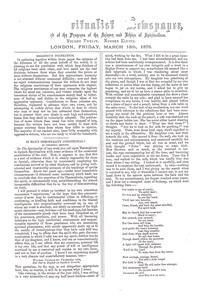
In gathering together within these pages the opinions of the followers of all the great beliefs of the world, it is pleasing to see the gentleness with which deep thinkers of all religions treat each other, and how small are the real divisions between them when they consider the points at issue without dogmatism. But this approximate harmony is not attained without occasional difficulty; now and then we reject communications because the writers do not treat the religious convictions of their opponents with respect. The religious sentiments of any man comprise the highest ideals his mind can conceive, and violent attacks upon the innermost shrine of his consciousness merely lead to bitterness of feeling and dislike to the religious ideas of his aggressive opponent. Contributors to these columns are, therefore, requested to advance their own views, not by attempting to rudely shiver that which is dear to others who may or may not be less advanced than themselves, but to present their own ideals in such high and attractive forms that they shall be voluntarily adopted. The publication of more letters than usual has been stopped of late, because the writers have not been careful to treat with proper courtesy those from whom they differ in opinion. The majority of our readers also, have little sympathy with aggressive writers, who are too ready to wield the tomahawk.
Is Man's Immortality Conditional?
In The Spiritualist of last week you call upon Theosophists to furnish Spiritualists with some evidence of the occasional annihilation of the soul. Now, it appears to me, that this is a sort of evidence which it is clearly impossible for them to furnish, otherwise than by consistently employing the conclusions arrived at by other thinkers, and by giving well-attested and trustworthy accounts of the teachings of spirits themselves. About two years ago—under most remarkable circumstances—I obtained some testimony which leads me to conclude that this assertion of the Theosophists, regarding the spirit, is substantially true, notwithstanding the almost insuperable difficulties that lie in the way of demonstrating its truth.
I will proceed to relate an incident in my own somewhat uncommon “experiences,” in the hope that this communication of mine may be instrumental either in diffusing, or confirming, or kindling faith and confidence in the blessed intelligences who unquestionably surround us, in one of whom my trust is absolute, not solely on account of the high moral character—nay, holiness—of his teachings, but because of the incontestable proofs that have been furnished us, of his prescience, prevision, and power. With all becoming deference to the high intellectual attainments and unquestionable sincerity of those gentlemen who are examining spiritual phenomena, with minds apparently made up as to the results of investigations that they have only half way completed, I beg to affirm that the spirit who gave the communication to which I refer was not my spirit, neither was he that of my daughter, and I know, and can as conscientiously affirm this, as I can affirm that my conscious, personal life is my own life, and that any power of will or intelligence exercised by me is conceived and resides in my own brain, and not in that of another. I know I am expressing myself in a very obscure and unsatisfactory manner, but—
Was kein Verstand der Verstandige sieht, |
This quotation, by the way, is not altogether appropriate here, but, no matter, it will do to express what I mean.
One evening, in the winter of the year 1876,1 was sitting in a very miserable—I may say half heart-broken—state of mind, working by the fire. What I felt to be a great injustice had been done me. I had been misunderstood, and my actions had been maliciously misrepresented. It is true there was a consciousness of my own integrity and a trust in a Higher Power to support me, nevertheless life seemed like a dark labyrinth in which I was wandering about most dejectedly—in a word, nothing was to be discerned clearly <... continues on page 7-12 >
Editor's notes
- ↑ image by unknown author. colored picture
- ↑ Col. Olcott on "The Ghost" by Olcott, H. S., Evening Telegram, The, v. 11, No. 3918, March 26, 1878, p. 3
- ↑ Ever faithful by unknown author. colored picture
- ↑ Religious Toleration by unknown author, London Spiritualist, No. 290, March 15, 1878, p. 121
- ↑ Is Man's Immortality Conditional? by Showers, Frederica, London Spiritualist, No. 290, March 15, 1878, pp. 121-2. "Chameleon africanus"
Sources
-
London Spiritualist, No. 290, March 15, 1878, p. 121
-
Evening Telegram, v. 11, No. 3918, March 26, 1878, p. 3