
HPB-SB-10-42: Difference between revisions
mNo edit summary |
mNo edit summary |
||
| (One intermediate revision by the same user not shown) | |||
| Line 14: | Line 14: | ||
“On the evening of the 24th January, after prayers by the priests, and the lamps being extinguished, the ghost rapped once and came in. As the wench again sat on the same chest between the priests, the curate of Laagkh felt his hair tugged, and he rose up. Ankha at the same time exclaimed, ‘Oh dear! oh dear! whose cold hand is that?’ The priest, who was sitting near, said, ‘Don’t be afraid, the hand is mine,’ but this was not true. He wished to do away with her fright, and with the impression caused by the touch. | “On the evening of the 24th January, after prayers by the priests, and the lamps being extinguished, the ghost rapped once and came in. As the wench again sat on the same chest between the priests, the curate of Laagkh felt his hair tugged, and he rose up. Ankha at the same time exclaimed, ‘Oh dear! oh dear! whose cold hand is that?’ The priest, who was sitting near, said, ‘Don’t be afraid, the hand is mine,’ but this was not true. He wished to do away with her fright, and with the impression caused by the touch. | ||
“On the 25th of January, when all the required masses had been said at the altar of Saint Anthony of Jagnenz, the Lord of Weixelstein and the priests engaged in the ceremony returned to pass the night at the castle, and' to receive the thanksgiving of the Saved Soul. While they were supping the housemaid, carrying the children’s food, was crossing the hall to the dining-room, when the ghost seized her arm. She started back, and saw behind her the form of a woman robed in white. As the family was retiring to rest, the lord of the castle ordered two of his dependants, Christop Wollf and Mathew Wreschekh, to pass the night with the servant wenches in the haunted room. As the lamps were put out the ghost entered and struck a loud rap upon the table, and said, ‘Ankha, now I am saved, and I am going to heaven! The wench rejoined, ‘O, blessed soul, pray to Heaven for me, for the noble master, the noble mistress, and all the noble family, and for all those who helped thee to (attain) their eternal salvation,’ whereto the ghost answered ‘Amen, amen, amen.’ It then went towards Ankha, and privily told the promised secret, strictly forbidding | “On the 25th of January, when all the required masses had been said at the altar of Saint Anthony of Jagnenz, the Lord of Weixelstein and the priests engaged in the ceremony returned to pass the night at the castle, and' to receive the thanksgiving of the Saved Soul. While they were supping the housemaid, carrying the children’s food, was crossing the hall to the dining-room, when the ghost seized her arm. She started back, and saw behind her the form of a woman robed in white. As the family was retiring to rest, the lord of the castle ordered two of his dependants, Christop Wollf and Mathew Wreschekh, to pass the night with the servant wenches in the haunted room. As the lamps were put out the ghost entered and struck a loud rap upon the table, and said, ‘Ankha, now I am saved, and I am going to heaven! The wench rejoined, ‘O, blessed soul, pray to Heaven for me, for the noble master, the noble mistress, and all the noble family, and for all those who helped thee to (attain) their eternal salvation,’ whereto the ghost answered ‘Amen, amen, amen.’ It then went towards Ankha, and privily told the promised secret, strictly forbidding her to divulge it. | ||
“Finally, it should be noted that before all these events Ankha had confessed and communicated.”— ''(From translation.) '' | “Finally, it should be noted that before all these events Ankha had confessed and communicated.”— ''(From translation.) '' | ||
| Line 25: | Line 25: | ||
| item = 1 | | item = 1 | ||
| type = article | | type = article | ||
| status = | | status = proofread | ||
| continues = 43, 44 | | continues = 43, 44 | ||
| author = Dixon J. M. | | author = Dixon J. M. | ||
| Line 31: | Line 31: | ||
| subtitle = | | subtitle = | ||
| untitled = | | untitled = | ||
| source title = Spiritualist | | source title = London Spiritualist | ||
| source details = No. 369, September 19, 1879, pp. 140-142 | | source details = No. 369, September 19, 1879, pp. 140-142 | ||
| publication date = 1879-09-19 | | publication date = 1879-09-19 | ||
| Line 39: | Line 39: | ||
}} | }} | ||
... | <center>By the Rev. J. M. Dixon.</center> | ||
{{Style S-HPB SB. Continues on|10-43}} | {{Style S-Small capitals| I well}} remember the time when young, middleaged, and old people seriously and deliberately told their dreams of the night and the meanings of them. Those people had their canons of interpretation for dreams, and some people were regarded by the dreamers as recognised interpreters. When it was shown that physical derangement and mental anxiety were common causes of dreaming, and that in the imperfect sleep of the night the imagination and fancy ran wild, the dream-mongers were not''' '''well pleased. But the fact remained that some dreams; were not the result of bodily or mental unhealthiness. It is held by some that sleep is the sister of death, that state of physical passiveness in which the human soul may sometimes have revelations which it cannot have when the body is awake with all its instincts and passions. Mr. R. D. Owen says—“But while we admit, what facts abundantly prove, that, in a I great majority of instances, dreams are, or may be, either the breaking forth in sleep of a strong desire, I or the offspring of fancy running riot beyond the control of the judgment, or else the result of suggestion, sometimes direct and intentional, more frequently proceeding apparently by accident from antecedent thoughts or emotions, there remain to be dealt with certain exceptional cases, which do not seem to be properly included in any of the above categories. To judge understandingly of these, it behoves us to examine them somewhat in detail.” Mr. Owen then gives several cases of remarkable dreams, a few of which I here transcribe:— | ||
“I remember while walking one beautiful day in June, in the Villa Reale (the fashionable park of Naples, having a magnificent view over the bay), one recounted to me by a member of the A—Legation, one of the most intelligent and agreeable acquaintances I made in that city. | |||
“On the 16th of October, 1850, being then in the city of Naples, this gentleman dreamed that he was by the bedside of his father, who appeared to be in the agonies of death, and that after a time lie saw him expire. He awoke in a state of great excitement, bathed in cold perspiration, and the impression on his mind was so strong that he immediately rose, although it was still night, dressed himself, and wrote to his father, inquiring after his health. His father was then at Trieste, distant from Naples, by the nearest route, five days’ journey; and the son had no cause whatever, except the above dream, to be uneasy about him, seeing that his age did not exceed fifty, and that no intelligence of his illness, or even indisposition, had been received. He waited for a reply with some anxiety for three weeks, at the end {{Style S-HPB SB. Continues on|10-43}} | |||
{{HPB-SB-footer-footnotes}} | {{HPB-SB-footer-footnotes}} | ||
{{HPB-SB-footer-sources}} | |||
<gallery widths=300px heights=300px> | |||
london_spiritualist_n.369_1879-09-19.pdf|page=10|London Spiritualist, No. 369, September 19, 1879, pp. 140-142 | |||
</gallery> | |||
Latest revision as of 14:47, 14 August 2024
 |
vol. title: vol. period: 1879-1880 pages in vol.: 577 |
< “Veritable and Singular Account of an Apparition, and the Saving of a Soul, in Castle Weixelstein, in Krain.” (continued from page 10-41) >
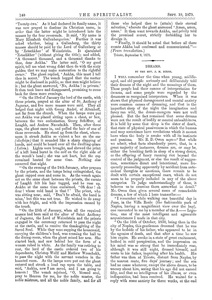
‘Twenty-two.’ As it had declared its family name, it was now prayed to disclose' its Christian name, in order that the latter might be introduced into the masses by the four reverends. It said, ‘My name is Mary Elizabeth Gallenbergerinn.’ Further it was asked whether, being a Gallenbcrg, thc thirty masses should be paid by the Lord of Gollenberg or by ‘Zetschkher’ of Weixelstein. It ejaculated ‘Zetschkher’ (without giving the title); and added, ‘A thousand thousand, and a thousand thanks to thee, dear Ankha.’ The latter said, ‘O my good spirit, tell me what wrong didst thou do with the sixty gulden that we may make restoration to the rightful owner.’ The ghost replied, ‘Ankha, this must I tell thee in secret.’ The wench begged that the matter might be disclosed in public, so that men might believe it; but the ghost answered, ‘No, Ankha! in private.’ It then took leave and disappeared, promising to come back for three more evenings.
“On the 23rd of January the lord of the castle, with three priests, prayed at the altar of St. Anthony of Jagnenz, and five more masses were said. They all lodged that night with Georg Andre, of Altcnhoff, not far from the church. When the lamps were put out Ankha was placed sitting upon a chest, or box, between the two ecclesiastics, Georg Schiffrer, of Laagkh, and Andree Navadnikh. Then, after three raps, the ghost came in, and pulled the hair of one of these reverends. He stood up from the chest, whereupon it struck Ankha so violent a box on the ear (ohrfeige) that it sounded like a sharp clapping of bands, and could be heard over all the dwelling-place (Laban). Lights were brought, and showed the print of a left hand burnt in the coif on the right side of the wench’s head; she was not hurt, but the cap remained heated for some time. Nothing else occurred that night.
“On the evening of the 24th January, after prayers by the priests, and the lamps being extinguished, the ghost rapped once and came in. As the wench again sat on the same chest between the priests, the curate of Laagkh felt his hair tugged, and he rose up. Ankha at the same time exclaimed, ‘Oh dear! oh dear! whose cold hand is that?’ The priest, who was sitting near, said, ‘Don’t be afraid, the hand is mine,’ but this was not true. He wished to do away with her fright, and with the impression caused by the touch.
“On the 25th of January, when all the required masses had been said at the altar of Saint Anthony of Jagnenz, the Lord of Weixelstein and the priests engaged in the ceremony returned to pass the night at the castle, and' to receive the thanksgiving of the Saved Soul. While they were supping the housemaid, carrying the children’s food, was crossing the hall to the dining-room, when the ghost seized her arm. She started back, and saw behind her the form of a woman robed in white. As the family was retiring to rest, the lord of the castle ordered two of his dependants, Christop Wollf and Mathew Wreschekh, to pass the night with the servant wenches in the haunted room. As the lamps were put out the ghost entered and struck a loud rap upon the table, and said, ‘Ankha, now I am saved, and I am going to heaven! The wench rejoined, ‘O, blessed soul, pray to Heaven for me, for the noble master, the noble mistress, and all the noble family, and for all those who helped thee to (attain) their eternal salvation,’ whereto the ghost answered ‘Amen, amen, amen.’ It then went towards Ankha, and privily told the promised secret, strictly forbidding her to divulge it.
“Finally, it should be noted that before all these events Ankha had confessed and communicated.”— (From translation.)
Trieste, September 8, 1879.
Dreams
I well remember the time when young, middleaged, and old people seriously and deliberately told their dreams of the night and the meanings of them. Those people had their canons of interpretation for dreams, and some people were regarded by the dreamers as recognised interpreters. When it was shown that physical derangement and mental anxiety were common causes of dreaming, and that in the imperfect sleep of the night the imagination and fancy ran wild, the dream-mongers were not well pleased. But the fact remained that some dreams; were not the result of bodily or mental unhealthiness. It is held by some that sleep is the sister of death, that state of physical passiveness in which the human soul may sometimes have revelations which it cannot have when the body is awake with all its instincts and passions. Mr. R. D. Owen says—“But while we admit, what facts abundantly prove, that, in a I great majority of instances, dreams are, or may be, either the breaking forth in sleep of a strong desire, I or the offspring of fancy running riot beyond the control of the judgment, or else the result of suggestion, sometimes direct and intentional, more frequently proceeding apparently by accident from antecedent thoughts or emotions, there remain to be dealt with certain exceptional cases, which do not seem to be properly included in any of the above categories. To judge understandingly of these, it behoves us to examine them somewhat in detail.” Mr. Owen then gives several cases of remarkable dreams, a few of which I here transcribe:—
“I remember while walking one beautiful day in June, in the Villa Reale (the fashionable park of Naples, having a magnificent view over the bay), one recounted to me by a member of the A—Legation, one of the most intelligent and agreeable acquaintances I made in that city.
“On the 16th of October, 1850, being then in the city of Naples, this gentleman dreamed that he was by the bedside of his father, who appeared to be in the agonies of death, and that after a time lie saw him expire. He awoke in a state of great excitement, bathed in cold perspiration, and the impression on his mind was so strong that he immediately rose, although it was still night, dressed himself, and wrote to his father, inquiring after his health. His father was then at Trieste, distant from Naples, by the nearest route, five days’ journey; and the son had no cause whatever, except the above dream, to be uneasy about him, seeing that his age did not exceed fifty, and that no intelligence of his illness, or even indisposition, had been received. He waited for a reply with some anxiety for three weeks, at the end <... continues on page 10-43 >
Editor's notes
- ↑ Dreams by Dixon J. M., London Spiritualist, No. 369, September 19, 1879, pp. 140-142
Sources
-
London Spiritualist, No. 369, September 19, 1879, pp. 140-142