
HPB-SB-12-81: Difference between revisions
mNo edit summary |
mNo edit summary |
||
| Line 11: | Line 11: | ||
| item =1 | | item =1 | ||
| type =article | | type =article | ||
| status = | | status = proofread | ||
| continues =82 | | continues =82 | ||
| author = M.A. (Oxon) | | author = M.A. (Oxon) | ||
| Line 25: | Line 25: | ||
}} | }} | ||
... | <center>'''Contributed by “M.A. (Oxon.)”'''</center> | ||
{{Style S-HPB SB. Continues on|12-82}} | Probably no one has suffered more from persistent misrepresentation and calumny than Madame Blavatsky. Few in England know what sacrifices she has made for what to her is the cause of truth, nor the social position which she has abandoned in order to defend and propagate it. I am glad to have an opportunity of reproducing some facts from a letter written in answer to a stupid attack recently made by the ''Saturday lieview ''on herself and Colonel Olcott. The writer of this letter is Mr. A. O. Hume, late secretary to the Government of India, and it is published in the ''Civil and Military Gazette, ''of India, and in the ''Pioneer Mail, ''of Allahabad. Mr. Hume’s position is such as to lend added weight to his words. He writes thus: — | ||
“Madame Blavatsky in Russia is ‘Son Excellence Madame la Generale Helene P. Blavatsky’ though she dropped all titles on becoming a naturalized American citizen. She is the widow of General N. V. Blavatsky, Governor during the Crimean War, and for many years, of Erivan in Armenia. She is the eldest daughter of the late Colonel Hahn, of the Russian Horse Artillery, and grand-daughter of Princess Dolgorouki of the elder branch which died with her. The present Princess Dolgorouki belongs to the younger branch. The Countess Ida V. Hahn Hahn was Madame Blavatsky’s father’s first cousin. Her father’s mother married, after her husband’s death, Prince Vassiltchikoff. General Fadayeff, well known even to English readers, is her mother’s youngest brother. She is well known to Prince Loris Melikoff, and all who were on the staff or in society when Prince Michael S. Woronzoff was Viceroy of the Caucasus. Prince Emile V. Sayn Wittgenstein, cousin of the late Empress of Russia, was an intimate friend of hers, and corresponded with her to the day of his death, as has done his brother Ferdinand, who lately commanded some regiment (Cossacks of the Guard, I think), in Turkestan. Her aunt, Madame de Wittd, who, like the rest of her family, corresponded regularly with her, and, indeed, her whole family, are well known to Prince Dounonkoff Karsakoff, at present Governor-General of Odessa. | |||
“I could add the names of scores of other Russian nobles who are well acquainted with her; for she is as well known and connected in Russia as Lady Hester Stanhope was in England; but I think I have said enough to convince any impartial person that she is scarcely the kind of woman likely to be an ‘unscrupulous adventuress.’” | |||
Mr. Hume further says: — “To my certain knowledge, Colonel Olcott and Madame Blavatsky have spent on the Theosophical Society over £2,000 more than its total receipts. The accounts have been regularly audited, printed, and published, so that any one may satisfy himself.” | |||
The objects and aims of tho Society are thus succinctly stated: — | |||
1st. To form the nucleus of an Universal Brotherhood of Humanity. | |||
2nd. To study Aryan literature, religion, and science. | |||
3rd. To vindicate the importance of this inquiry. | |||
4th. To explore the hidden mysteries of nature and the latent powers of man. | |||
{{HPB-CW-separator}} | |||
''Blackwood ''has always had a speciality for good ghost stories. It begins the new year with “The Open Door,” one of the most striking I ever read. If I may except to a very clumsy suggestion, which closes the narrative with a crumb of comfort for the incredulous, the whole story, whether true or false, is extremely realistic and ''rraisemblable. ''It is told with vigour, is inscribed with an air of reality “to'' ''a dear and happy memory,” and is the work of one who allows his belief in what he narrates to peep out repeatedly. I will not attempt to analyse the narrative, nor spoil pleasure by canvassing some of the statements. Anyone who takes up the magazine will not want his delight broken in upon by rationalistic suggestions. | |||
{{HPB-CW-separator}} | |||
It is a strange anomaly that a magazine like ''Blackwood’s ''will publish, with all the honours of prominent position, a full flavoured ghost story, but would scornfully decline to give a back corner to attested facts which prove what the story imaginatively describes. Ghosts are to be confined to fiction! Meantime, the thinking world increasingly concerns itself with experimental investigations into their manners and customs. I suppose the time will come when an editor will see that a scientifically attested fact, even about a ghost, is at least as well worth attention as a highly imaginative and creepy story. | |||
{{HPB-CW-separator}} | |||
I am far from undervaluing the importance of the evidence which has led Dr. Wyld to his conclusion respecting the power of the incarnated human Spirit; and I fully appreciate the significance of the case (already familiar to me) which he quotes. I am anxious that-, in dealing with these and kindred cases, conclusions should not be one-sided. ''In medio tutissimus ''applies eminently here. Dealing with the same subject in June, 1877, I wrote: “In the eagerness to prove the return of departed Spirits of humanity, too little heed has been paid to the fact that oven in our circles all does not proceed from that source.” I set myself to do what I could to induce Spiritualists to consider the evidence for trans corporeal action of the human Spirit. There is, I think, a little danger now with some writers that the action of the disembodied human Spirit may be quite ignored or denied, and undue powers claimed, on evidence that will not carry the superstructure, for the embodied Spirit of man. A good deal of the applicability of Dr. Wyld’s narrative to the special matter under debate lies in one little point. Did the door-handle ''positively ''turn, and was the door ''absolutely ''opened? If so, the apparition was able to act upon a material object. Is this surely established? If not, it might have been, what is far more usual, a mere apparition made temporarily visible to the two observers, of whom Dr. Wyld had the impression or evidence of only one. ''I ''should say that the ghost ''was ''the ghost of Miss J., though of this we are of no means sure: and I should say that the inherent power of her Spirit did produce, unconsciously to herself, the recorded results. Whether, however, this was the product of her imagination, when in a state of reverie, whether it was her unaided work, is another matter. Tho case is very rare, and we must not build on ^exceptional records whore so much is mysterious and uncertain. It is, however, an excellent case, and Dr. Wyld is entitled to its benefit. | |||
{{HPB-CW-separator}} | |||
In lately reading again Epes Sargent’s “Planchette,” I have hit upon two more confessions of conjurers, which I am glad to reprint as an addition to those which have already appeared in “Light.” They proceeded from M. Hamilton, a conjurer, and M. Rhys, a manufacturer of conjuring implements, who worked for Robert Houdin; —two excellent judges of the matters on which they spoke. The letters were published in the ''Gazette des Etrangers, ''Paris, on September 27th, 18G5; they relate to the Davenports, and are as follow: — | |||
“Messrs. Davenport. —Yesterday I had the pleasure of being present at the stance you gave; and I came away from it convinced that jealousy alone was the cause of the outcry raised against you. The phenomena produced surpassed my expectations: and your experiments were full of interest for me. I Consider it my duty to add that ''those phenomena are inexplicable, ''and the more so by such persons as have thought themselves able to {{Style S-HPB SB. Continues on|12-82}} | |||
{{HPB-SB-footer-footnotes}} | {{HPB-SB-footer-footnotes}} | ||
Latest revision as of 04:04, 16 November 2025
 |
vol. title: vol. period: 1882 pages in vol.: 231 |
Notes by the Way
Probably no one has suffered more from persistent misrepresentation and calumny than Madame Blavatsky. Few in England know what sacrifices she has made for what to her is the cause of truth, nor the social position which she has abandoned in order to defend and propagate it. I am glad to have an opportunity of reproducing some facts from a letter written in answer to a stupid attack recently made by the Saturday lieview on herself and Colonel Olcott. The writer of this letter is Mr. A. O. Hume, late secretary to the Government of India, and it is published in the Civil and Military Gazette, of India, and in the Pioneer Mail, of Allahabad. Mr. Hume’s position is such as to lend added weight to his words. He writes thus: —
“Madame Blavatsky in Russia is ‘Son Excellence Madame la Generale Helene P. Blavatsky’ though she dropped all titles on becoming a naturalized American citizen. She is the widow of General N. V. Blavatsky, Governor during the Crimean War, and for many years, of Erivan in Armenia. She is the eldest daughter of the late Colonel Hahn, of the Russian Horse Artillery, and grand-daughter of Princess Dolgorouki of the elder branch which died with her. The present Princess Dolgorouki belongs to the younger branch. The Countess Ida V. Hahn Hahn was Madame Blavatsky’s father’s first cousin. Her father’s mother married, after her husband’s death, Prince Vassiltchikoff. General Fadayeff, well known even to English readers, is her mother’s youngest brother. She is well known to Prince Loris Melikoff, and all who were on the staff or in society when Prince Michael S. Woronzoff was Viceroy of the Caucasus. Prince Emile V. Sayn Wittgenstein, cousin of the late Empress of Russia, was an intimate friend of hers, and corresponded with her to the day of his death, as has done his brother Ferdinand, who lately commanded some regiment (Cossacks of the Guard, I think), in Turkestan. Her aunt, Madame de Wittd, who, like the rest of her family, corresponded regularly with her, and, indeed, her whole family, are well known to Prince Dounonkoff Karsakoff, at present Governor-General of Odessa.
“I could add the names of scores of other Russian nobles who are well acquainted with her; for she is as well known and connected in Russia as Lady Hester Stanhope was in England; but I think I have said enough to convince any impartial person that she is scarcely the kind of woman likely to be an ‘unscrupulous adventuress.’”
Mr. Hume further says: — “To my certain knowledge, Colonel Olcott and Madame Blavatsky have spent on the Theosophical Society over £2,000 more than its total receipts. The accounts have been regularly audited, printed, and published, so that any one may satisfy himself.”
The objects and aims of tho Society are thus succinctly stated: —
1st. To form the nucleus of an Universal Brotherhood of Humanity.
2nd. To study Aryan literature, religion, and science.
3rd. To vindicate the importance of this inquiry.
4th. To explore the hidden mysteries of nature and the latent powers of man.
Blackwood has always had a speciality for good ghost stories. It begins the new year with “The Open Door,” one of the most striking I ever read. If I may except to a very clumsy suggestion, which closes the narrative with a crumb of comfort for the incredulous, the whole story, whether true or false, is extremely realistic and rraisemblable. It is told with vigour, is inscribed with an air of reality “to a dear and happy memory,” and is the work of one who allows his belief in what he narrates to peep out repeatedly. I will not attempt to analyse the narrative, nor spoil pleasure by canvassing some of the statements. Anyone who takes up the magazine will not want his delight broken in upon by rationalistic suggestions.
It is a strange anomaly that a magazine like Blackwood’s will publish, with all the honours of prominent position, a full flavoured ghost story, but would scornfully decline to give a back corner to attested facts which prove what the story imaginatively describes. Ghosts are to be confined to fiction! Meantime, the thinking world increasingly concerns itself with experimental investigations into their manners and customs. I suppose the time will come when an editor will see that a scientifically attested fact, even about a ghost, is at least as well worth attention as a highly imaginative and creepy story.
I am far from undervaluing the importance of the evidence which has led Dr. Wyld to his conclusion respecting the power of the incarnated human Spirit; and I fully appreciate the significance of the case (already familiar to me) which he quotes. I am anxious that-, in dealing with these and kindred cases, conclusions should not be one-sided. In medio tutissimus applies eminently here. Dealing with the same subject in June, 1877, I wrote: “In the eagerness to prove the return of departed Spirits of humanity, too little heed has been paid to the fact that oven in our circles all does not proceed from that source.” I set myself to do what I could to induce Spiritualists to consider the evidence for trans corporeal action of the human Spirit. There is, I think, a little danger now with some writers that the action of the disembodied human Spirit may be quite ignored or denied, and undue powers claimed, on evidence that will not carry the superstructure, for the embodied Spirit of man. A good deal of the applicability of Dr. Wyld’s narrative to the special matter under debate lies in one little point. Did the door-handle positively turn, and was the door absolutely opened? If so, the apparition was able to act upon a material object. Is this surely established? If not, it might have been, what is far more usual, a mere apparition made temporarily visible to the two observers, of whom Dr. Wyld had the impression or evidence of only one. I should say that the ghost was the ghost of Miss J., though of this we are of no means sure: and I should say that the inherent power of her Spirit did produce, unconsciously to herself, the recorded results. Whether, however, this was the product of her imagination, when in a state of reverie, whether it was her unaided work, is another matter. Tho case is very rare, and we must not build on ^exceptional records whore so much is mysterious and uncertain. It is, however, an excellent case, and Dr. Wyld is entitled to its benefit.
In lately reading again Epes Sargent’s “Planchette,” I have hit upon two more confessions of conjurers, which I am glad to reprint as an addition to those which have already appeared in “Light.” They proceeded from M. Hamilton, a conjurer, and M. Rhys, a manufacturer of conjuring implements, who worked for Robert Houdin; —two excellent judges of the matters on which they spoke. The letters were published in the Gazette des Etrangers, Paris, on September 27th, 18G5; they relate to the Davenports, and are as follow: —
“Messrs. Davenport. —Yesterday I had the pleasure of being present at the stance you gave; and I came away from it convinced that jealousy alone was the cause of the outcry raised against you. The phenomena produced surpassed my expectations: and your experiments were full of interest for me. I Consider it my duty to add that those phenomena are inexplicable, and the more so by such persons as have thought themselves able to <... continues on page 12-82 >
Editor's notes
- ↑ Notes by the Way by M.A. (Oxon), Light, v. 2, No. 56, January 28, 1882, pp. 37-8
Sources
-
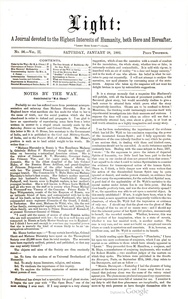
Light, v. 2, No. 56, January 28, 1882, pp. 37-8