
HPB-SB-12-86: Difference between revisions
(Created page with "{{HPB-SB-header | volume =12 | page =86 | image = SB-12-086.jpg | notes = }} {{Style P-HPB SB. Title continued |The Conduct of Circles|12-85}} {{HPB-SB-item | volume =12 | page =86 | item =1 | type = article | status = wanted | continues = | author =Wedgwood, Hensleigh | title =Haunted Monastery at Baden-Baden | subtitle = | untitled = | source title = | source details = | publication date = | original date = | notes = | categories = }} ... {{HPB...") |
mNo edit summary |
||
| (One intermediate revision by the same user not shown) | |||
| Line 6: | Line 6: | ||
}} | }} | ||
{{Style P-HPB SB. Title continued | | {{Style P-HPB SB. Title continued |Advice to Inquirers|12-85}} | ||
{{Style P-No indent|any vexatious imposition of restrictions on free communication. Let the Intelligence use its own means: if the attempt to communicate deserves your attention, it probably has something to say to you, and will resent being hampered by useless interference. It rests greatly with the sitters to make the manifestations elevating or frivolous, and even tricky.}} | |||
Should an attempt be made to entrance the medium, or to manifest by any violent methods, or by means of form-manifestations, ask that the attempt may be deferred till you can secure the presence of some experienced Spiritualist. If this request is not heeded, discontinue the sitting. The process of developing a trance-medium is one that might disconcert an inexperienced inquirer. Increased light will check noisy manifestations. | |||
Lastly—Try the results you get by the light of Reason. Maintain a level head and a clear judgment. Do not believe everything you are told, for though the great unseen world contains many a wise and discerning Spirit, it also has in it the accumulation of human folly, vanity, and error; and this lies nearer to the surface than that which is wise and good. Distrust the free use of great names. Never for a moment abandon the use of your Reason. Do not enter into a very solemn investigation in a spirit of idle curiosity or frivolity. Cultivate a reverent desire for what is pure, good, and true. You will be repaid if you gain only a well-grounded conviction that there is a life after death, for which a pure and good life before death is the best and wisest preparation. | |||
{{HPB-SB-item | {{HPB-SB-item | ||
| Line 13: | Line 19: | ||
| item =1 | | item =1 | ||
| type = article | | type = article | ||
| status = | | status = proofread | ||
| continues = | | continues = | ||
| author =Wedgwood, Hensleigh | | author =Wedgwood, Hensleigh | ||
| Line 19: | Line 25: | ||
| subtitle = | | subtitle = | ||
| untitled = | | untitled = | ||
| source title = | | source title = Light | ||
| source details = | | source details = v. 2, No. 56, January 28, 1882, p. 42 | ||
| publication date = | | publication date = 1882-01-22 | ||
| original date = | | original date = | ||
| notes = | | notes = | ||
| Line 27: | Line 33: | ||
}} | }} | ||
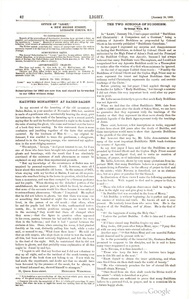
... | In my account of the haunting of the old monastery at Baden-Baden, in your number of November 19th last, mention is made of a gentleman who, accidentally hearing the story, gave his testimony to the truth of the haunting up to a recent period, saying that he and his brother had passed a night in the house for the sake of seeing the ghost, who came and turned over the leaves of a book they were reading. In this statement there is some confusion and jumbling together of the facts that actually occurred. By the kindness of Miss G––, my original in formant, I was enabled to trace the gentleman, a clergyman, referred to in the foregoing passage, who answered my application in the most obliging manner. | ||
“The subject,” he says, “is of great interest to me, for I am one of those who have been brought into personal contact with ghosts and hauntings, with the result that I am absolutely convinced of the existence of such phenomena as cannot be explained on any other than supernatural grounds. | |||
“But my knowledge of the occurrences at Baden was not acquired by personal experience. I will, however, state all I know about this remarkable old house. In the autumn of 1875, when staying with my brother at Baden, I met an old acquaintance who was then living in the house in question, which had once been a monastery, and was then occupied by a German professor and his pupils. When shewing me the detached portion of the establishment, the ancient part, in which he lived, he observed that none of the servants would live there because it was subject to extraordinary phenomena. ‘Ghosts?''’ ''I inquired. He replied that he did not believe in ghosts, but that there was some one or something that haunted at night the rooms in which he lived, in the person of an old monk;—that often, when he and the pupils had left their books, mathematical instruments, &c., in certain positions arranged to renew work in the morning,* they would find them all changed when they arose;—that the figure in question often appeared in his room, passing between his bed and the window (we were then in the bedroom,) and that it had † peered between the curtains at him. Once, when entering his room, it hail plucked forcibly at his coat, distinctly pulling him back, while a voice said, or seemed to say, ‘What doest thou here?’ Ho told me that an able sceptic, who slept there in order to test the truth of all this, had been most seriously frightened, and left the house in the dead of the night. Still, lie maintained that he did not believe in ghosts, and that probably some explanation of all this might be found by-and-bye. | |||
“I regret to add that my brother and I did not volunteer to stay up all night, and so the incident of the monk turning over the leaves of the book does not belong to us. I now wish we had made the experiment, and doubt not that we should have been favoured by the presence of the monk, for he always, as my friend informed my, shewed himself to strangers.” | |||
{{Style P-Signature in capitals|Hensleigh Wedgwood.}} | |||
31, Queen Anne-street. | |||
{{Footnotes start}} | |||
<nowiki>*</nowiki> It is doubtless a mis-recollection of this incident which gave rise to the story of the ghost turning over the leaves of the book. | |||
† Compare this with the complaint of Mrs. G.’s little girl more than 30 yours before, that when she woke at night the monk was making faces at the foot of her bed. | |||
{{Footnotes end}} | |||
{{HPB-SB-item | {{HPB-SB-item | ||
| Line 34: | Line 56: | ||
| item =2 | | item =2 | ||
| type = article | | type = article | ||
| status = | | status = proofread | ||
| continues = | | continues = 87 | ||
| author =Wild, George | | author =Wild, George | ||
| title =The Two Schools of Buddhism | | title =The Two Schools of Buddhism | ||
| subtitle = | | subtitle = | ||
| untitled = | | untitled = | ||
| source title = | | source title = Light | ||
| source details = | | source details = v. 2, No. 56, January 28, 1882, pp. 42-3 | ||
| publication date = | | publication date = 1882-01-22 | ||
| original date = | | original date = | ||
| notes = | | notes = | ||
| Line 48: | Line 70: | ||
}} | }} | ||
... | <center>'''By George Wyld, M.D.''' {{Style S-HPB SB. HPB note |F.T.S.}}</center> | ||
In {{Style S-Small capitals| “Light,”}} January 7th, I had a paper entitled “Buddhism and Christianity: A Comparison and a Contrast,1’ being a criticism of Agnostic Buddhism as propounded by Colonel Olcott in his recently published “ Buddhistic Catechism.” | |||
In that paper I expressed my surprise and disappointment on finding that Buddhism, as defined by Colonel Olcott and as authorised by the High Priest of Adam’s Peak and the Principal of the Buddhist College, was ''Agnostic, ''because I had always believed that many Buddhists were Theosophists, and I could not comprehend how any Agnostic Buddhist could be a Theosophist or seeker after the wisdom of a God whose existence he ignored. | |||
At the end of my paper I added these words: “Possibly the Buddhism of Colonel Olcott and the Ceylon High Priest may no more represent the truest and highest Buddhism than the ordinary verbal Christianity represents the mystic and esoteric teachings of the Christ.’’ | |||
Before printing my last paper I had applied through my bookseller for Lillie’s “Early Buddhism,” but through a mistake I did not obtain this very important book until after my paper was in print. | |||
Mr. Lillie seems distinctly to prove that much Early Buddhism was not Agnostic. | |||
When we find that the oldest Buddhistic MSS. date from 1,600 to 2,000 years after the death of Sakya-Muni, we can have no guarantee that they represent truly the teachings of the founder or that they represent his ideas more closely than the monkish legends of the Bark Ages represent truly the teachings of Jesus. | |||
There exist, however, a few inscriptions on rocks, supposed to date from about 250 years after the death of Buddha, and these inscriptions would seem to shew that Agnostic Buddhism is the growth of the after ages. | |||
But however that may be, Mr. Lillie demonstrates that many of the most important Buddhistic MSS. teach doctrines the reverse of Agnostic. | |||
In my first paper I have said that the Buddhism as propounded by Colonel Olcott and the Ceylon High Priest seemed to ignore an intelligent God, and to make no mention of holiness, of prayer, or of individual immortality. | |||
Mr. Lillie, however, shews by very many quotations from important MSS. that many Buddhists believe in a personal God; in saints living in Paradise; in the efficacy of prayer to God and to the saints; while Nirvana is described, not as an abstract idea, but as a place or paradise for the blessed. | |||
In illustration of these views I make the following quotations from his book. With regard to God and to prayer to God, it is said:— | |||
“Those who follow religious observances shall be taught to follow in the right way and give glory to God.” | |||
“In Buddha God was revealed in the form of Mercy.” | |||
“Adi Buddha is without beginning; he is perfect and pure, the essence of wisdom and truth. He knows all and is ever present. He tenderly loves those who serve him. He is the Creator of all the Buddhas, ''and of Akasa. ''He is the God of Gods.” | |||
“O! the happiness of seeing the Holy One.” | |||
“I adore the perfect Buddha. I offer to him and I confess my sins.” | |||
“If I have sinned may Buddha forgive my sins.” | |||
King Asoka, 250 years after Sakya-Muni, says; “I pray that all with me may attain unto eternal salvation.” | |||
Another says: “O that Sakya-Muni and our merciful Father would descend and be present with us.” | |||
As to the personality of the immortal life, Gautama-Buddha promised to reappear to his disciples, and he is said to have many times reappeared as a person. | |||
As to Nirvana, it is thus described:— | |||
“Those who keep the laws of the heavens have happiness in this life and in the next.” | |||
“Exert thyself to obtain the inner quickening, and when once freed from sin thou shalt roach the world of beauty.” | |||
“He who virtuously preaches the law of eternal life shall himself obtain Nirvana.” | |||
“Once freed from sin thou shalt reach the Divine world of the saints’’—which is described as a ''place.'' | |||
These extracts are sufficient to prove that many Buddhists believe in a personal God, in prayer, and in a conscious life in a future happy abode. | |||
{{Style S-HPB SB. Continues on|12-87}} | |||
{{HPB-SB-footer-footnotes}} | {{HPB-SB-footer-footnotes}} | ||
{{HPB-SB-footer-sources}} | |||
<gallery widths=300px heights=300px> | |||
Light_v.02_n.56_1882-01-28.pdf|page=6|Light, v. 2, No. 56, January 28, 1882, p. 42 | |||
</gallery> | |||
Latest revision as of 04:51, 16 November 2025
 |
vol. title: vol. period: 1882 pages in vol.: 231 |
< Advice to Inquirers (continued from page 12-85) >
any vexatious imposition of restrictions on free communication. Let the Intelligence use its own means: if the attempt to communicate deserves your attention, it probably has something to say to you, and will resent being hampered by useless interference. It rests greatly with the sitters to make the manifestations elevating or frivolous, and even tricky.
Should an attempt be made to entrance the medium, or to manifest by any violent methods, or by means of form-manifestations, ask that the attempt may be deferred till you can secure the presence of some experienced Spiritualist. If this request is not heeded, discontinue the sitting. The process of developing a trance-medium is one that might disconcert an inexperienced inquirer. Increased light will check noisy manifestations.
Lastly—Try the results you get by the light of Reason. Maintain a level head and a clear judgment. Do not believe everything you are told, for though the great unseen world contains many a wise and discerning Spirit, it also has in it the accumulation of human folly, vanity, and error; and this lies nearer to the surface than that which is wise and good. Distrust the free use of great names. Never for a moment abandon the use of your Reason. Do not enter into a very solemn investigation in a spirit of idle curiosity or frivolity. Cultivate a reverent desire for what is pure, good, and true. You will be repaid if you gain only a well-grounded conviction that there is a life after death, for which a pure and good life before death is the best and wisest preparation.
Haunted Monastery at Baden-Baden
In my account of the haunting of the old monastery at Baden-Baden, in your number of November 19th last, mention is made of a gentleman who, accidentally hearing the story, gave his testimony to the truth of the haunting up to a recent period, saying that he and his brother had passed a night in the house for the sake of seeing the ghost, who came and turned over the leaves of a book they were reading. In this statement there is some confusion and jumbling together of the facts that actually occurred. By the kindness of Miss G––, my original in formant, I was enabled to trace the gentleman, a clergyman, referred to in the foregoing passage, who answered my application in the most obliging manner.
“The subject,” he says, “is of great interest to me, for I am one of those who have been brought into personal contact with ghosts and hauntings, with the result that I am absolutely convinced of the existence of such phenomena as cannot be explained on any other than supernatural grounds.
“But my knowledge of the occurrences at Baden was not acquired by personal experience. I will, however, state all I know about this remarkable old house. In the autumn of 1875, when staying with my brother at Baden, I met an old acquaintance who was then living in the house in question, which had once been a monastery, and was then occupied by a German professor and his pupils. When shewing me the detached portion of the establishment, the ancient part, in which he lived, he observed that none of the servants would live there because it was subject to extraordinary phenomena. ‘Ghosts?’ I inquired. He replied that he did not believe in ghosts, but that there was some one or something that haunted at night the rooms in which he lived, in the person of an old monk;—that often, when he and the pupils had left their books, mathematical instruments, &c., in certain positions arranged to renew work in the morning,* they would find them all changed when they arose;—that the figure in question often appeared in his room, passing between his bed and the window (we were then in the bedroom,) and that it had † peered between the curtains at him. Once, when entering his room, it hail plucked forcibly at his coat, distinctly pulling him back, while a voice said, or seemed to say, ‘What doest thou here?’ Ho told me that an able sceptic, who slept there in order to test the truth of all this, had been most seriously frightened, and left the house in the dead of the night. Still, lie maintained that he did not believe in ghosts, and that probably some explanation of all this might be found by-and-bye.
“I regret to add that my brother and I did not volunteer to stay up all night, and so the incident of the monk turning over the leaves of the book does not belong to us. I now wish we had made the experiment, and doubt not that we should have been favoured by the presence of the monk, for he always, as my friend informed my, shewed himself to strangers.”
31, Queen Anne-street.
* It is doubtless a mis-recollection of this incident which gave rise to the story of the ghost turning over the leaves of the book.
† Compare this with the complaint of Mrs. G.’s little girl more than 30 yours before, that when she woke at night the monk was making faces at the foot of her bed.
The Two Schools of Buddhism
In “Light,” January 7th, I had a paper entitled “Buddhism and Christianity: A Comparison and a Contrast,1’ being a criticism of Agnostic Buddhism as propounded by Colonel Olcott in his recently published “ Buddhistic Catechism.”
In that paper I expressed my surprise and disappointment on finding that Buddhism, as defined by Colonel Olcott and as authorised by the High Priest of Adam’s Peak and the Principal of the Buddhist College, was Agnostic, because I had always believed that many Buddhists were Theosophists, and I could not comprehend how any Agnostic Buddhist could be a Theosophist or seeker after the wisdom of a God whose existence he ignored.
At the end of my paper I added these words: “Possibly the Buddhism of Colonel Olcott and the Ceylon High Priest may no more represent the truest and highest Buddhism than the ordinary verbal Christianity represents the mystic and esoteric teachings of the Christ.’’
Before printing my last paper I had applied through my bookseller for Lillie’s “Early Buddhism,” but through a mistake I did not obtain this very important book until after my paper was in print.
Mr. Lillie seems distinctly to prove that much Early Buddhism was not Agnostic.
When we find that the oldest Buddhistic MSS. date from 1,600 to 2,000 years after the death of Sakya-Muni, we can have no guarantee that they represent truly the teachings of the founder or that they represent his ideas more closely than the monkish legends of the Bark Ages represent truly the teachings of Jesus.
There exist, however, a few inscriptions on rocks, supposed to date from about 250 years after the death of Buddha, and these inscriptions would seem to shew that Agnostic Buddhism is the growth of the after ages.
But however that may be, Mr. Lillie demonstrates that many of the most important Buddhistic MSS. teach doctrines the reverse of Agnostic.
In my first paper I have said that the Buddhism as propounded by Colonel Olcott and the Ceylon High Priest seemed to ignore an intelligent God, and to make no mention of holiness, of prayer, or of individual immortality.
Mr. Lillie, however, shews by very many quotations from important MSS. that many Buddhists believe in a personal God; in saints living in Paradise; in the efficacy of prayer to God and to the saints; while Nirvana is described, not as an abstract idea, but as a place or paradise for the blessed.
In illustration of these views I make the following quotations from his book. With regard to God and to prayer to God, it is said:—
“Those who follow religious observances shall be taught to follow in the right way and give glory to God.”
“In Buddha God was revealed in the form of Mercy.”
“Adi Buddha is without beginning; he is perfect and pure, the essence of wisdom and truth. He knows all and is ever present. He tenderly loves those who serve him. He is the Creator of all the Buddhas, and of Akasa. He is the God of Gods.”
“O! the happiness of seeing the Holy One.”
“I adore the perfect Buddha. I offer to him and I confess my sins.”
“If I have sinned may Buddha forgive my sins.”
King Asoka, 250 years after Sakya-Muni, says; “I pray that all with me may attain unto eternal salvation.”
Another says: “O that Sakya-Muni and our merciful Father would descend and be present with us.”
As to the personality of the immortal life, Gautama-Buddha promised to reappear to his disciples, and he is said to have many times reappeared as a person.
As to Nirvana, it is thus described:—
“Those who keep the laws of the heavens have happiness in this life and in the next.”
“Exert thyself to obtain the inner quickening, and when once freed from sin thou shalt roach the world of beauty.”
“He who virtuously preaches the law of eternal life shall himself obtain Nirvana.”
“Once freed from sin thou shalt reach the Divine world of the saints’’—which is described as a place.
These extracts are sufficient to prove that many Buddhists believe in a personal God, in prayer, and in a conscious life in a future happy abode.
<... continues on page 12-87 >
Editor's notes
Sources
-
Light, v. 2, No. 56, January 28, 1882, p. 42