
HPB-SB-12-183: Difference between revisions
(Created page with "{{HPB-SB-header | volume = 12 | page = 183 | image = SB-12-183.jpg | notes = }}") |
mNo edit summary |
||
| (One intermediate revision by the same user not shown) | |||
| Line 5: | Line 5: | ||
| notes = | | notes = | ||
}} | }} | ||
{{HPB-SB-item | |||
| volume = 12 | |||
| page = 183 | |||
| item = 1 | |||
| type = article | |||
| status = proofread | |||
| continues = 184 | |||
| author = M.A. (Oxon) | |||
| title = Notes by the Way | |||
| subtitle = “The Perfect Way”* | |||
| untitled = | |||
| source title = Light | |||
| source details = v. 2, No. 62, March 11, 1882, pp. 109-10 | |||
| publication date = 1882-03-11 | |||
| original date = | |||
| notes = | |||
| categories = | |||
}} | |||
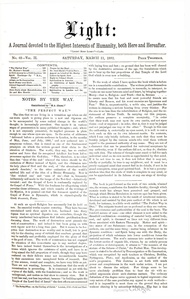
The idea that we are living in a transition age when an old out-worn epoch is giving place to a new and vigorous era to be accompanied by some radical change in the world’s thought, is increasingly prevalent. One meets it in various stages of presentation in many published thoughts; and, where it is not expressly presented, its implied presence is plain enough to one whose eyes are open. In the series of addresses “delivered before a private audience in London, in the months of May, June, and July, 1881,” and now gathered into a sumptuous volume, this is stated as one of the fundamental principles on which the writers ground their claim to the attention of thinkers. The world, they say, has so exalted matter and force that its recognised intellect has been led to pronounce against the God-idea. “This, therefore, is no other than that ‘time of the end’ whereof the token should be the exaltation of Matter instead of Spirit, and the obtrusion into the holy place of God and the soul, of ‘the abomination that maketh desolate,’ to the utter extinction of the world’s spiritual life and of the idea of a Divine Humanity. Now is ‘that wicked one’ and ‘man of sin’—that is, humanity deliberately self-made in the image of the Not-God—definitively revealed: and the Gospel of Love is confessedly replaced by the Gospel of Force.” With the fondness for allegorizing which pervades these addresses, and which smacks of the writings of the Mystics, it is pointed out that the foremost symbol of the Gospel of Force is Dynamite, which is etymologically the Greek ''dunamis'', Force. | |||
{{HPB-CW-separator}} | |||
At such an epoch Religion has necessarily lost its hold on men. Its essential truths require restating. They have become materialised until their spirit is lost, hardened into flinty dogmas that no spiritual digestion can assimilate, though the merely intellectual hair-splitters find infinite gratification from discussing them. The work of destruction must precede the work of construction; and indeed it has been going on with much vigour now for a long time past. But it seems to be forgotten that destruction is no worthy end in itself, but is good only for the clearing away of rubbish that cumbers ground that may be usefully and profitably employed for the glory of God or the good of man. The work of construction has not engaged the attention of this iconoclastic age in any marked degree. Men have indeed busied themselves in the investigations of a science which ignores the existence of spirit, and have in so doing missed the full proportion of truth, though they may have conferred on their fellows some not inconsiderable benefits by their excursions into unexplored fields of research. But of true science, round and complete, we have very little as yet. There are not wanting, however, indications that the work of reconstruction is proceeding. It is concerned as yet with the ''origines'' of the faith, with the foundations; and so the work is underground, and makes no fair show to cursory view. But it is not less real, nor less important, because “in building again the Temple of the Lord God of Israel” the first efforts are concerned with laying firm and fast, on ground that has been well cleared by the destructive criticism of the age, the foundations which are to bear up the fair proportions of that Temple of the Lord God which is even now a-building. | |||
{{HPB-CW-separator}} | |||
To the work of which I have spoken the book which is before me is a remarkable contribution. The writers profess themselves to be commissioned to reconstruct, to reconcile, to interpret, to “make at-one-ment between mind and heart, by bringing together Mercy—that is, Religion—and Truth—that is, Science . . . to assure man that his best and most powerful friends are Liberty and Reason, and his worst enemies are Ignorance and Fear.” This is, unquestionably, a noble aim, and justifies the writers in claiming a serious hearing from every thinker. For the aim is no less than the rehabilitation of Religion, and the restatement of Divine Truth. In carrying out this purpose, the authors preserve a complete anonymity, “in order that their work may rest upon its own merits, and not upon theirs—real or supposed; in order, that is, that it may be judged and not prejudged one way or the other.” Though in this case the authorship is esoterically an open secret, it is well to rest a book such as this on its own inherent merits. Its contents, which I can only briefly indicate, are such that they must be frankly judged by the various minds who read them without regard to the presumed authority of any name. They are not of a character that can be prescribed for universal acceptance by any authority, even if the authors did not, as they do, disclaim any such idea. The scheme of thought must stand or fall for each individual mind on its own merits as apprehended by that mind. If it be not true to me, it does not follow that it may not, wholly or partially, be true to my neighbour, and it must be a poorly equipped mind that cannot find in its details, if not in its grand conception, some good spiritual food. It is but a poverty-stricken idea that the circle of truth is complete in any mind, or can be apprehended in its fulness at any one stage of development. | |||
{{HPB-CW-separator}} | |||
The book is put forward as the work of two minds, whereof one, the woman, contributes the Intuitive faculty, through which esoteric truth has always been perceived and grasped, and through which Divine Revelation in various ages has been given. What is written is stated to be the result of intuitional memory, developed and assisted by that pure method of life which is set forth, for instance, in a little work entitled “The Perfect Way in Diet.” The subjects treated are as profound as they are various. The pre-existence and perfectibility of the soul is the basis. The fourfold nature of man—one other element is now added to the threefold combination—consisting of material body, astral body, soul, and spirit, is discussed on lines not very different from those associated with Eastern Theosophy. Matter and spirit— two states of one Substance—are, in the conception of the authors, one and the same thing: matter being substance in its dynamic condition: and Spirit being one with the Deity, the projection of which substance into lower conditions forms the material universe. The soul’s entrance into matter is traced to the lowest modes of organic life, whence, by an orderly process of evolution or development, it attains to “the measure of the stature of the fulness of Christ,” the Perfect Man. This development is stated to be effected by Transmigration or Re-Incarnation, which was recognised by such teachers as Chrishna, Buddha, Pythagoras, Plato, and Apollonius, as the method of the soul’s progression. This doctrine is set forth with much power and completeness in the work under notice. I am not about to discuss the subject. Few things seem to me more absolutely profitless than to beat the air with so-called arguments about such abstruse matters. The ordinary defenders of the dogma never approach to logical argument—the very nature of the case precludes any appeal to such methods— and it is impossible to meet them on the ground they select without clearing it by antecedent definition. The fact is that {{Style S-HPB SB. Continues on|12-184}} | |||
{{Footnotes start}} | |||
<nowiki>*</nowiki> “The Perfect Way; or, the Finding of Christ.” London, 1882—Field and Tuer. | |||
{{Footnotes end}} | |||
{{HPB-SB-footer-footnotes}} | |||
{{HPB-SB-footer-sources}} | |||
<gallery widths=300px heights=300px> | |||
Light_v.02_n.62_1882-03-11.pdf|page=1|Light, v. 2, No. 62, March 11, 1882, pp. 109-10 | |||
</gallery> | |||
Latest revision as of 06:06, 16 November 2025
 |
vol. title: vol. period: 1882 pages in vol.: 231 |
Notes by the Way
The idea that we are living in a transition age when an old out-worn epoch is giving place to a new and vigorous era to be accompanied by some radical change in the world’s thought, is increasingly prevalent. One meets it in various stages of presentation in many published thoughts; and, where it is not expressly presented, its implied presence is plain enough to one whose eyes are open. In the series of addresses “delivered before a private audience in London, in the months of May, June, and July, 1881,” and now gathered into a sumptuous volume, this is stated as one of the fundamental principles on which the writers ground their claim to the attention of thinkers. The world, they say, has so exalted matter and force that its recognised intellect has been led to pronounce against the God-idea. “This, therefore, is no other than that ‘time of the end’ whereof the token should be the exaltation of Matter instead of Spirit, and the obtrusion into the holy place of God and the soul, of ‘the abomination that maketh desolate,’ to the utter extinction of the world’s spiritual life and of the idea of a Divine Humanity. Now is ‘that wicked one’ and ‘man of sin’—that is, humanity deliberately self-made in the image of the Not-God—definitively revealed: and the Gospel of Love is confessedly replaced by the Gospel of Force.” With the fondness for allegorizing which pervades these addresses, and which smacks of the writings of the Mystics, it is pointed out that the foremost symbol of the Gospel of Force is Dynamite, which is etymologically the Greek dunamis, Force.
At such an epoch Religion has necessarily lost its hold on men. Its essential truths require restating. They have become materialised until their spirit is lost, hardened into flinty dogmas that no spiritual digestion can assimilate, though the merely intellectual hair-splitters find infinite gratification from discussing them. The work of destruction must precede the work of construction; and indeed it has been going on with much vigour now for a long time past. But it seems to be forgotten that destruction is no worthy end in itself, but is good only for the clearing away of rubbish that cumbers ground that may be usefully and profitably employed for the glory of God or the good of man. The work of construction has not engaged the attention of this iconoclastic age in any marked degree. Men have indeed busied themselves in the investigations of a science which ignores the existence of spirit, and have in so doing missed the full proportion of truth, though they may have conferred on their fellows some not inconsiderable benefits by their excursions into unexplored fields of research. But of true science, round and complete, we have very little as yet. There are not wanting, however, indications that the work of reconstruction is proceeding. It is concerned as yet with the origines of the faith, with the foundations; and so the work is underground, and makes no fair show to cursory view. But it is not less real, nor less important, because “in building again the Temple of the Lord God of Israel” the first efforts are concerned with laying firm and fast, on ground that has been well cleared by the destructive criticism of the age, the foundations which are to bear up the fair proportions of that Temple of the Lord God which is even now a-building.
To the work of which I have spoken the book which is before me is a remarkable contribution. The writers profess themselves to be commissioned to reconstruct, to reconcile, to interpret, to “make at-one-ment between mind and heart, by bringing together Mercy—that is, Religion—and Truth—that is, Science . . . to assure man that his best and most powerful friends are Liberty and Reason, and his worst enemies are Ignorance and Fear.” This is, unquestionably, a noble aim, and justifies the writers in claiming a serious hearing from every thinker. For the aim is no less than the rehabilitation of Religion, and the restatement of Divine Truth. In carrying out this purpose, the authors preserve a complete anonymity, “in order that their work may rest upon its own merits, and not upon theirs—real or supposed; in order, that is, that it may be judged and not prejudged one way or the other.” Though in this case the authorship is esoterically an open secret, it is well to rest a book such as this on its own inherent merits. Its contents, which I can only briefly indicate, are such that they must be frankly judged by the various minds who read them without regard to the presumed authority of any name. They are not of a character that can be prescribed for universal acceptance by any authority, even if the authors did not, as they do, disclaim any such idea. The scheme of thought must stand or fall for each individual mind on its own merits as apprehended by that mind. If it be not true to me, it does not follow that it may not, wholly or partially, be true to my neighbour, and it must be a poorly equipped mind that cannot find in its details, if not in its grand conception, some good spiritual food. It is but a poverty-stricken idea that the circle of truth is complete in any mind, or can be apprehended in its fulness at any one stage of development.
The book is put forward as the work of two minds, whereof one, the woman, contributes the Intuitive faculty, through which esoteric truth has always been perceived and grasped, and through which Divine Revelation in various ages has been given. What is written is stated to be the result of intuitional memory, developed and assisted by that pure method of life which is set forth, for instance, in a little work entitled “The Perfect Way in Diet.” The subjects treated are as profound as they are various. The pre-existence and perfectibility of the soul is the basis. The fourfold nature of man—one other element is now added to the threefold combination—consisting of material body, astral body, soul, and spirit, is discussed on lines not very different from those associated with Eastern Theosophy. Matter and spirit— two states of one Substance—are, in the conception of the authors, one and the same thing: matter being substance in its dynamic condition: and Spirit being one with the Deity, the projection of which substance into lower conditions forms the material universe. The soul’s entrance into matter is traced to the lowest modes of organic life, whence, by an orderly process of evolution or development, it attains to “the measure of the stature of the fulness of Christ,” the Perfect Man. This development is stated to be effected by Transmigration or Re-Incarnation, which was recognised by such teachers as Chrishna, Buddha, Pythagoras, Plato, and Apollonius, as the method of the soul’s progression. This doctrine is set forth with much power and completeness in the work under notice. I am not about to discuss the subject. Few things seem to me more absolutely profitless than to beat the air with so-called arguments about such abstruse matters. The ordinary defenders of the dogma never approach to logical argument—the very nature of the case precludes any appeal to such methods— and it is impossible to meet them on the ground they select without clearing it by antecedent definition. The fact is that <... continues on page 12-184 >
* “The Perfect Way; or, the Finding of Christ.” London, 1882—Field and Tuer.
Editor's notes
- ↑ Notes by the Way by M.A. (Oxon), Light, v. 2, No. 62, March 11, 1882, pp. 109-10
Sources
-
Light, v. 2, No. 62, March 11, 1882, pp. 109-10