
HPB-SB-1-2: Difference between revisions
(Created page with "{{HPB-SB-header | volume = 1 | page = 2 | image = SBI-002.jpg | notes = | prev = 1 | next = 3 }} {{Style P-HPB SB. Object title|{{Style S-HPB SB. Editors note|picture}...") |
mNo edit summary |
||
| (9 intermediate revisions by 2 users not shown) | |||
| Line 2: | Line 2: | ||
| volume = 1 | | volume = 1 | ||
| page = 2 | | page = 2 | ||
| image = | | image = SB-01-002.jpg | ||
| notes = | | notes = | ||
}} | }} | ||
{{ | {{HPB-SB-item | ||
{{Style P-HPB SB. | | volume = 1 | ||
| page = 2 | |||
| item = 1 | |||
| type = image | |||
| status = improved | |||
| author = | |||
| title = Row of Hindoo Temples at the Foot of Fort Ulwar | |||
| notes = | |||
| categories = | |||
| hide = yes | |||
}} | |||
[[File:SB-01-002-1.jpg|600px|center|Row of Hindoo Temples at the Foot of Fort Ulwar]] | |||
{{Style P-HPB SB. Image title|Row of Hindoo Temples at the Foot of Fort Ulwar}} | |||
{{HPB-SB-item | |||
| volume = 1 | |||
| page = 2 | |||
| item = 2 | |||
| type = image | |||
| status = improved | |||
| author = | |||
| title = A Hindoo Shrine and Choultry | |||
| notes = | |||
| categories = | |||
| hide = yes | |||
}} | |||
[[File:SB-01-002-2.jpg|600px|center|A Hindoo Shrine and Choultry]] | |||
{{Style P-HPB SB. Image title|A Hindoo Shrine and Choultry}} | |||
{{HPB-SB-footer-footnotes}} | |||
{{HPB-SB-footer-sources}} | |||
<gallery widths=400px heights=400px> | |||
Vinay Vilas Mahal.jpg | |||
Vinay Vilas Mahal_mono.jpg|City Palace or Vinay Vilas Mahal at Alwar Rajasthan India, from the Illustrated London News, 1874. | |||
</gallery> | |||
{{Vertical space|}} | |||
The City Palace, also known as Vinay Vilas Mahal, built in 1793 CE by Raja Bakhtawar Singh, blends the Rajputana and Islamic architectural styles and has marble pavilions on lotus-shaped bases in its courtyard. The palace houses a state museum with a collection of manuscripts, including one depicting Emperor Babur’s life, Ragamala paintings and miniatures, and historic swords that once belonged to Muhammad Ghori, Emperor Akbar and Aurangzeb; and a golden Durbar hall. This palace that once belonged to the Maharaja (lit. Great Ruler) has now been converted into a District Administrative office also housing the District Court. ([https://www.kulbeli.com/post/post/84 kulbeli.com]) | |||
<gallery widths=400px heights=400px> | |||
SB-01-002-source-2.jpg|''A Hindoo Shrine and Choultry'' — ''The Illustrated Sporting and Dramatic News'', 28 November 1874, p. 212. Scan: Bayerische Staatsbibliothek. | |||
</gallery> | |||
{{Vertical space|}} | |||
''A Hindoo Shrine and Choultry'' — ''The Illustrated Sporting and Dramatic News'', 28 November 1874, printed p. 212. [https://mdz-nbn-resolving.de/urn:nbn:de:bvb:12-bsb11305745-7 Bayerische Staatsbibliothek München], 2 Gymn. 100 i-2, urn:nbn:de:bvb:12-bsb11305745-7, digitized by Google; [https://rightsstatements.org/vocab/NoC-NC/1.0/ NoC-NC 1.0]. | |||
Latest revision as of 03:55, 31 October 2026
 |
vol. title: vol. period: pages in vol.: |

Row of Hindoo Temples at the Foot of Fort Ulwar

A Hindoo Shrine and Choultry
Editor's notes
Sources
-

-

City Palace or Vinay Vilas Mahal at Alwar Rajasthan India, from the Illustrated London News, 1874.


The City Palace, also known as Vinay Vilas Mahal, built in 1793 CE by Raja Bakhtawar Singh, blends the Rajputana and Islamic architectural styles and has marble pavilions on lotus-shaped bases in its courtyard. The palace houses a state museum with a collection of manuscripts, including one depicting Emperor Babur’s life, Ragamala paintings and miniatures, and historic swords that once belonged to Muhammad Ghori, Emperor Akbar and Aurangzeb; and a golden Durbar hall. This palace that once belonged to the Maharaja (lit. Great Ruler) has now been converted into a District Administrative office also housing the District Court. (kulbeli.com)
-
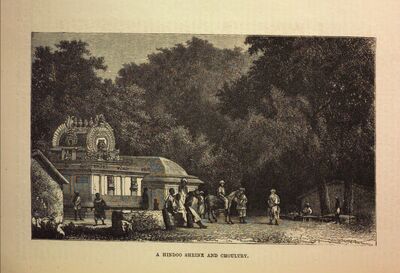
A Hindoo Shrine and Choultry — The Illustrated Sporting and Dramatic News, 28 November 1874, p. 212. Scan: Bayerische Staatsbibliothek.

A Hindoo Shrine and Choultry — The Illustrated Sporting and Dramatic News, 28 November 1874, printed p. 212. Bayerische Staatsbibliothek München, 2 Gymn. 100 i-2, urn:nbn:de:bvb:12-bsb11305745-7, digitized by Google; NoC-NC 1.0.