
HPB-SB-8-23: Difference between revisions
mNo edit summary |
mNo edit summary |
||
| Line 40: | Line 40: | ||
There is indeed a perhaps unavoidable want of precision in a somewhat rhetorical paper which is misleading. | There is indeed a perhaps unavoidable want of precision in a somewhat rhetorical paper which is misleading. | ||
“We accept the doctrine of the immortality of the human spirit,” should read evidently from what follows, “the ''potential ''immortality.” The doctrine is stated categorically that man is composed of a physical body, an astral body (double, or soul), and “these two are overshadowed (illuminated and spiritualised) by the divine immortal spirit, the ''ruach ''or '' | “We accept the doctrine of the immortality of the human spirit,” should read evidently from what follows, “the ''potential ''immortality.” The doctrine is stated categorically that man is composed of a physical body, an astral body (double, or soul), and “these two are overshadowed (illuminated and spiritualised) by the divine immortal spirit, the ''ruach ''or ''νοῦς. ''If then Col. Olcott merely means that the ''νοῦς ''is immortal though the man be not, his statement is a little misleading, for most readers will gather from his words that Theosophists accept-the usually received doctrine of Immortality of the human spirit. | ||
It is important to state this clearly, for most of us hear, I fancy, for the first time through this paper of the doctrine of a duality in man overshadowed, as by something separate, by a divine spirit. We have fought about distinctions between Soul and Spirit, but we have pretty well agreed that man is tripartite, composed of Body, Soul, and Spirit—a Physical Body, a Spiritual Body, and “a particle of the Divine mind” indwelling, which most call Soul and some Spirit. But this doctrine of a separation between the ''vow ''and the man, normal at all times, and in frequent cases becoming permanent even before bodily death, is new to us. What does it lead to? Plainly to a doctrine as new as it is startling, viz., that in the physical life the efforts of the dual man must be directed to union with his ''Αὐγοειδης'';—his Divine Spirit—to avoid annihilation. Such as secure that union survive—the survival of the fittest—such as do not, become ''larvae, ''elementaries, and are finally annihilated. | It is important to state this clearly, for most of us hear, I fancy, for the first time through this paper of the doctrine of a duality in man overshadowed, as by something separate, by a divine spirit. We have fought about distinctions between Soul and Spirit, but we have pretty well agreed that man is tripartite, composed of Body, Soul, and Spirit—a Physical Body, a Spiritual Body, and “a particle of the Divine mind” indwelling, which most call Soul and some Spirit. But this doctrine of a separation between the ''vow ''and the man, normal at all times, and in frequent cases becoming permanent even before bodily death, is new to us. What does it lead to? Plainly to a doctrine as new as it is startling, viz., that in the physical life the efforts of the dual man must be directed to union with his ''Αὐγοειδης'';—his Divine Spirit—to avoid annihilation. Such as secure that union survive—the survival of the fittest—such as do not, become ''larvae, ''elementaries, and are finally annihilated. | ||
Latest revision as of 10:03, 8 September 2025
 |
vol. title: Vol Four of The Theosophical Society of The Arya Samaj of Arya-wart vol. period: Sept 1878 – Sept 1879 pages in vol.: 350 |
The Views of the Theosophists
It will be obvious to any one who reads what I wrote about the Theosophical criticism, put forward by Col. Olcott, in The Spiritualist, on December 7th, that I did not pretend to deal with his views except incidentally and in so far as they affected my then point of view.
It would be unfair to leave them thus noticed, if I have any claim to notice them at all. Such claim as I can have rests upon the fact that anything that he says must commend itself to me on many grounds of personal sympathy and earnest desire to learn what I can, as well as from the fact that he transmits to us the teaching of the learned author of Isis Unveiled, the master key to all problems. Of himself he would command attention; he commands it still more on account of the store of knowledge to which he has had access. If he be not the rose, at any rate he has lived near it. And, lastly, he comes forward to enlighten us, and will be aided in his attempt by the pointing out of difficulties. He anticipates that there may be points left for solution, and I think he will not be sorry to have them pointed out in order that he may solve them hereafter.
Perhaps I shall put what I have to say into the most convenient form, if I take Col. Olcott’s paper in The Spiritualist, of December 7th, as it stands, and suggest my points of difficulty as they occur.
The first statement that strikes me is a claim of common cause with the Spiritualists against a common enemy. The enemy, I suppose, is Materialism. But how can Occultism and Spiritualism be regarded as “natural allies.” Perhaps my last paper dealt sufficiently with this point; but, not to put it too plainly, I should have thought that Occultism according to Olcott was the deadly foe of Spiritualism as interpreted by popular teachers. Indeed, I should have thought that the mission of Occultism was to strike at the root of the central theory of Spiritualism, and to discourage its practice altogether. If not, much in the President’s paper requires restating in more precise terms.
There is indeed a perhaps unavoidable want of precision in a somewhat rhetorical paper which is misleading.
“We accept the doctrine of the immortality of the human spirit,” should read evidently from what follows, “the potential immortality.” The doctrine is stated categorically that man is composed of a physical body, an astral body (double, or soul), and “these two are overshadowed (illuminated and spiritualised) by the divine immortal spirit, the ruach or νοῦς. If then Col. Olcott merely means that the νοῦς is immortal though the man be not, his statement is a little misleading, for most readers will gather from his words that Theosophists accept-the usually received doctrine of Immortality of the human spirit.
It is important to state this clearly, for most of us hear, I fancy, for the first time through this paper of the doctrine of a duality in man overshadowed, as by something separate, by a divine spirit. We have fought about distinctions between Soul and Spirit, but we have pretty well agreed that man is tripartite, composed of Body, Soul, and Spirit—a Physical Body, a Spiritual Body, and “a particle of the Divine mind” indwelling, which most call Soul and some Spirit. But this doctrine of a separation between the vow and the man, normal at all times, and in frequent cases becoming permanent even before bodily death, is new to us. What does it lead to? Plainly to a doctrine as new as it is startling, viz., that in the physical life the efforts of the dual man must be directed to union with his Αὐγοειδης;—his Divine Spirit—to avoid annihilation. Such as secure that union survive—the survival of the fittest—such as do not, become larvae, elementaries, and are finally annihilated.
This is a “new departure,” however much it may be sustained by reference to ancient authorities. It is one of very far-reaching import. We hope, therefore, that we may reasonably ask for any fair evidence—proof is out of the question—for the allegations; and for a more precise statement of the theory. Where, for instance, is my conscience? In the nearness or farness of my relations with my spirit? or in myself? Is it pretended that a man who has lost his relations with his spirit has no standard of right and wrong, or is the standard in himself only vitiated? And when does this disunion take place? When is a man’s chance gone? Judging by what one sees of public morality and intelligent spiritual desire, there must be a heap of crude matter here in this end of the nineteenth century. And, speaking for myself, I don’t quite see where the Gospel comes in in this Theosophist Greed. I hanker after the old and nobler faith that man has in him the promise and potency of Immortality that he may delay his realisation of his inheritance, that he may, in rare and obstinate cases of rejection of all light, sink into darkness and final death, but that for the children of men, at some far distant day, when it matters little, the darkness shall turn to light, the potency become fruition.
But to descend from faith to works. Col. Olcott admits that we have a certain amount of evidence of the action of the pure disembodied spirits in circles both when physical manifestations are permitted and when they are excluded; but he whittles away this concession very materially by suggesting all manner of sets off. It may be the “medium’s soul,” or “an elementary” or “an elemental.” How are we to know? Judge the tree by its fruits? Is that what I it comes to? Are we the judges? We—why we are hallucinated, biologised, or what not. We have our “prepossessions” excited. We believe, therefore we are satisfied. It is our faith. Surely we must have some better test. We must at least be protected from ourselves. To put it. What proof—apart from theory—is there of any of these statements? Let us reverse the process. The President of the Theosophical Society lays down a number of theories, and tells us to judge our facts by them. Let us, on the contrary, take our facts, and see how they square with his theories. Hot at all. Judged by experience the theory is— theory merely. If it be anything more, then, Col. Olcott will do us a service by laying it down on exact lines of demonstration.
And here I anticipate a probable objection. I may be told that these are matters which cannot be reduced to proof; that all I can ask for is a coherent theory, not a certified dogma. Admitted: provided it be understood that these are mere hypotheses resting on no substantial foundation. If there be a foundation, we shall all be glad to have I it set forth in the language of precision.
Elementals and elementaries again are very perplexing. When they first appeared upon the Theosophical carpet, we were told that the elementary was an embryo soul, waiting his opportunity for incarnation. Of the elemental we heard little. How, we read in Isis Unveiled (Vol. I. p. 310 sq.) an elaborate biography of the Elementary who would seem to be of three families: a, the larvae; b, the embryo; c, the elemental proper—having neither tangible bodies nor immortal spirits. This is the genealogy. And of the branches of the family the destiny of the first is to burn out; of the second, to be born into this world; and of the third—I do not know, but Mr. Fitz-Gerald has given us his equation.
In this statement I frankly say that I see nothing which I should feel it difficult to accept, but that is a different thing from believing on evidence or proof. Of that we have none. And this is the cry of any critic who deals with Theosophists. Evidence, proof, my good friends. Give us a foundation on which to build. At present you are raising a mere Chateau en Espagne—a fabric which wants foundation.
The argument against this is anticipated. “I may be told that spirits sometimes declare that immortality is the common heritage of man; that evolution is not a fact on the spiritual side of the universe; that the elementaries all finally become purified of sin.” Partly so. Pure spirits—judged by human standards—do deny that comprehensive doctrine of annihilation; they do say that few fail of final progress, though some do. So far as I know they affirm the doctrine of evolution, and impress on man the doctrine that he is the arbiter of his own destiny, that his evolution will be slow or rapid according as he works out his own salvation. The Gospel they proclaim seems to me to be one that needs no advocacy. Man, they say, makes his future, and is the arbiter of his own fate. He graves day by day a character which is permanent, and by virtue of it he goes to “his own place.” He works out his own salvation, and after his physical life is done with, he remedies often in sorrow and shame, the defalcations and sins of his life, and pays the penalty of his transgressions. Helps he has, and by their means he is led upward. But if, by a course of preferred vice, by ingrained preference for the “earthly, sensual, devilish” he chooses evil and refuses good, then, by the action of the same invincible law, he sinks lower and lower, till beyond hope. But these cases are few and far between.
But, says Col. Olcott, “who cares to offset the asseverations of such unverified and unverifiable witnesses against the accumulated experience of thousands of trained seers, not mediums, not controlled, but able to sound the profoundest depths of nature, and who have sounded it?”
Well, that is just one of the statements so freely made. Where are the seers? what are their records? and (far more important) how do they verify them to us? As to the unverifiable nature of statements made by spirits, admitting (for the sake of argument only) that such is the case, do not the spirit and the seer sail in the same boat? The spirit at any rate is in evidence; the seer as yet is not. We cannot fairly be expected to “find in the far East the proof” we ask for. We must at least have some ground for believing that all the wise men do come from that quarter.
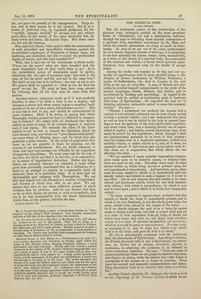
Another curious statement, made as if it were perfectly familiar, is this— “at birth a babe is but a duality, and becomes a trinity only when reason begins to manifest itself, usually at the age of seven years, but sometimes earlier.” This at any rate is new to me, and should be substantiated by some evidence. Shall I be wrong in saying that where Theosophy touches ground we have no difficulty in recognizing its beauty? We admit with all frankness that Spiritualism in some or many of its exoteric aspects is unlovely and of bad repute. We welcome the effort of the Theosophist to tell us how to remedy the blemishes which we have already seen, and which our “pure disembodied spirits” are never weary of dilating upon; and for which they also prescribe a plain remedy. In the midst of perplexities that beset us we are grateful to them for pointing out the sources of our bewilderment. But we would represent to them that they only increase our difficulty by the suggestion of unproven hypotheses. We want some rest for the sole of our foot, but we do not find it in rhetoric, or in supposition, or in mazes of hypothetical deduction. Before any hypothesis can seriously demand our attention it must either grow from previously ascertained fact as a deduction, or it must be an attempt to explain on a reasonable basis all observed facts of a particular class. It is here that we Spiritualists part company with Theosophists. We say that they import into the discussion a number of hypotheses and theories of which they offer us no proof. We say further that they do not make sufficient account of much evidence that we produce. And we say further still that, so far as their claims are proven or even vraisemblable, they are in no way incompatible with the truest Spiritualism which thus, as the greater, includes the less.
London, January 7th.
<Untitled> (Mr. J. Coates has...)
Mr. J. Coates has begun a series of twenty-four lectures on “Mesmerism,” at the Queen’s Hall, Liverpool. Last Monday evening the hall was so full that all the standing room was occupied.
Dr. Davies’s Lectures.—The Rev. C. M. Davies, D.D., will resume his lectures at the end of this month. They will be given in a drawing-room at the West-end of London, at three o’clock on Wednesday afternoons, and will be quite private. He will, however, be glad to forward cards of invitation, as far as practicable, to those desirous of attending. Dr. Davies may possibly make arrangements for lecturing on other days in different parts of London.
Strange Scene at the House of a Spiritualist.—A scene of a very exciting character was witnessed on Sunday night before the house of Mr. Edward Foster, druggist, Friargate, Preston, a noted Spiritualist and anti-vaccinator. Shortly after six o’clock a number of persons in the vicinity of Mr. Foster’s residence imagined that they saw a ghost, or spirit, in one of the upper rooms, and at once communicated the fact to other passers by. A large crowd speedily collected, and the appearance of the ghost was attributed to a seance that was thought to be going on in the room. The crowd increased, and became very noisy, the wildest rumours got afloat, and for the space of about two hours the thoroughfares, despite the endeavours of the police, were entirely blocked. No satisfactory clue was obtained as to the cause of the strange apparition which the hundreds of people positively asserted they saw, and at length the crowd, having spent itself in noise and surmises, gradually dispersed.—Northern Daily
Express, Dec. 18, 1877,
The Spiritual Body
The old heathenisb notion of the resurrection of the physical body, unhappily grafted on the most prevalent forms of Christianity, has had a mischievous influence through the ages in excluding those rational conceptions of a spiritual body, manifestly entertained by St. Paul, and which the present phenomena are doing so much to corroborate. As soon as we get out of the close, unwholesome air of a merely dogmatic system of theology, it is surprising to see how naturally the human reason turns, instinctively, as it were, to this theory of a spiritual body, the counterpart of the external and visible—a theory which spiritual manifestations have impressed even on the minds of savage tribes.
Among the books very popular in its day, and not unworthy of republication even in these crowded times, is The Religion of Nature Delineated, by William Wollaston, a native of Staffordshire, who died in London in the year 1724, at the age of sixty-five. A man of fortune and education he devoted himself independently to the study of the ancient languages, Greek, Hebrew, and Arabic, and to meditations in theology and psychology. In regard to the spiritual body he arrived at conclusions quite in harmony with those of Spiritualism. He regarded the soul as “a thinking substance intimately united to some fine material vehicle.” He says:—
“Though I understand not perfectly the manner how a cogitative and spiritual substance can be thus closely united to such a material vehicle; yet I can understand this union as well as how it can be united to the body in general (perhaps as how the particles of the body itself cohere together), and much better than how a thinking faculty can be superadded to matter; and beside, several phenomena may more easily be solved by this hypothesis; which (though I shall not pertinaciously maintain it) in short is this, namely: that the human soul is a cogitative substance, clothed in a material vehicle, or rather united to it, and, as it were, inseparably mixed—I had almost said incorporated—with it; that these act in conjunction, that which affects the one affecting the other. . . .
“We are sensible of many material impressions (impressions made upon us by material causes, or bodies)—that there are such we are sure. Therefore there must be some matter within us, which being moved or pressed upon, the soul apprehends it immediately. And therefore, again, there must be some matter to which it is immediately and intimately united, and related in such a manner as it is not to any other. Let us now suppose this said matter to be some refined and spirituous vehicle, which the soul doth immediately inform; with which it sympathises; by which it acts and is acted upon; and to which it is vitally and inseparably united. . . .
“By many symptoms it appears most probable that this matter, to which the mind is immediately present, and in which is its true Shekinah, is not the whole gross body, but some subtile body, placed in the region of the brain. . . . So if we should suppose the soul to be a being by nature made to inform some body, and that it cannot exist and act in a state of total separation from all body, it would not follow from hence that what we call death must therefore reduce it to a state of absolute insensibility and inactivity, which to it would be equal to non-existence. For that body, so necessary to it, may be some fine vehicle that dwells with it in the brain, and goes off with it at death.”
All this is substantially consistent with the deductions from the phenomena of Spiritualism. According to Chavee, the French physicist (who is not a Spiritualist), we contravene no known law of science, chemistry, physics or mechanics, in admitting the existence of an ethereal or electro-luminous organism. He says: “There are cases of positive pathology where we can grasp the superior organism, and observe its action, while the inferior one—that which is perceptible to the senses—is no longer in exercise. These cases are natural and mesmeric somnambulism and trance. Thus observation leads us to conclude that there is a future life.”
Another French physicist, Dr. Georget, who wrote a book on the Physiology of the Nervous System, in which he ex-<... continues on page 8-24 >
Editor's notes
- ↑ The Views of the Theosophists by unknown author (signed as M.A., Oxon), London Spiritualist, No. 281, January 11, 1878, pp. 16-7
- ↑ Mr. J. Coates has... by unknown author, London Spiritualist, No. 281, January 11, 1878, p. 17
- ↑ The Spiritual Body by Sargent, Epes, Spiritualist, The, No. 281, January 11, 1878, pp. 17-8
Sources
-

London Spiritualist, No. 281, January 11, 1878, pp. 16-7
-
London Spiritualist, No. 281, January 11, 1878, p. 17