HPB-SB-8-149

From Teopedia


from Adyar archives of the International Theosophical Society
vol. 8, p. 149

volume 8, page 149

vol. title: Vol Four of The Theosophical Society of The Arya Samaj of Arya-wart

vol. period: Sept 1878 – Sept 1879

pages in vol.: 350

Legend

  • HPB note
  • HPB highlighted
  • HPB underlined
  • HPB crossed out
  • <Editors note>
  • <Archivist note>
  • Lost or unclear
  • Restored
<<     >>
engрус


The Theosophists in Bombay

The deputation of the Theosophical Society of New York, who arrived from America a short time ago, made their first public appearance in Bombay at the Framjee Cowasjee Institute on Sunday afternoon. The deputation consists of Colonel H. S. Olcott, president of the Theosophical Society, late Special Commissioner of the War Department and the Navy Department of the United States; Mr. Edward Wimbridge, an English architect, formerly associated with Owen Jones of London; Miss Rosa Bates, an English lady; and Countess Helena P. Blavatski, corresponding secretary of the Theosophical Society, and authoress of “Isis Unveiled.” These four persons comprise the Committee sent from New York to confer with the Arya Samaj as to the best means of “disseminating among Western nations a correct knowledge of Oriental philosophy.” For the purpose of welcoming them to Bombay, a public meeting was called on Sunday by the Committee of the Hindu Dnyan Vurdhak Library, and it was arranged that Colonel Olcott should avail himself of the opportunity to give a lecture on “The Theosophical Society and its aims.” From 2 o’clock the Hall of the Institute was filled by throngs of native students with a sprinkling of European ladies and European and native gentlemen. The members of the deputation arrived shortly before 3 o’clock, and were accommodated with seats on the platform. Mr. Mahadeo Moreshwar Kunte, acting Professor of Sanscrit, Elphinstone College, was called to the chair, when Mr. Jugmohundas Samaldas, manager of the Hindu Dnyan Vurdhak Library, read a history of the origin and growth of the library, and he concluded by offering a welcome to the theosophists.

Colonel Olcott then read a paper on the abovementioned subject, which occupied him a little over an hour. The era of enquiry and of proof into received beliefs, he said, had come; and in appearing before the public of this country as elsewhere, the theosophists looked for no exemption from the same test. He believed there was a providential purpose in the simultaneous birth of theosophy at one end of the world and of the Arya Samaj under Dyanund Swami at the other. The Theosophical Society of New York could already point to four years of useful activity, which has had from its birth to face a good deal of antagonism, ridicule, and journalistic sarcasm for the privilege of free-speaking, and to bear clerical denunciations as being the specially-favoured of Satan. The Society received as brothers with equal cordiality Hindus, Parsis, Mahomedans, Jews, or Jains; and there was room for all on its platform. It was not in favour of Christian theology, or of any of the sects of which it is the mother. No Society, said the Colonel, had been talked about in so many countries as the Theosophical Society and the activity awakened in Oriental studies was directly traceable to its exertions. Adverting to the question of the constitution and aims of the Society, the lecturer referred to a number of questions he had received from correspondents since the subject of the lecture was announced,—which, he remarked, covered ground enough for thirty-four lectures. Those questions were mainly as to what attitude theosophists assumed towards religious belief; whether they believed in the immortality of the human soul; what were their ideas of the next world, &c. Most of these questions, the Colonel affirmed, were discussed in “Isis Unveiled”—a work which had been called by one journal “a stupendous monument of human industry.” The chief principle of theosophy was to speak the truth at any cost; to utter what its professors believed without equivocation or mental reservation. But they were at the same time investigators of truth with an earnest purpose and an unbiassed mind, determined at all hazards to hold fast to what was good; they were, however, students, not teachers. They had their secrets which harmed no one; and they made use of signs and tokens as some means of identification among members in the same way as was done among Freemasons. They had no political aims; and they admitted no one into their body who was engaged in schemes which militated against the State or against the public peace. The insinuation that some of them were political spies was as ridiculous as it was unfounded; and the Colonel said that the authoress of “Isis Unveiled” was the only Russian among them—and she had become a citizen of the United States. The lecturer averred that no theosophist would ever dream of hostility to the British Government—which was a most stable, wise, and just Government. The chief aim of the Society was to make men better, wiser, and more loyal than it found them. It intended to establish agencies in the East; but it had no dogma to offer and no propaganda to assail. Theosophist believed in the immortality of the human soul. Among other objects the deputation had come to this country to learn what occult science and philosophy which was known here in ancient times could teach. As a Society, their principle was:—

Know then thyself—presume not God to scan:
The proper study of mankind is man.

The Colonel recommended the establishment of a national Samaj, exhorting young India to rise above the prejudices of Caste and to have the moral courage at every step to practise what they preached. The members of the deputation had chosen this land as their home, and here they would live and die.

The lecturer was frequently interrupted by loud and repeated rounds of applause; and the proceedings terminated with a vote of thanks to him and to the chairman.

<Untitled> (We beg to remind...)

We beg to remind our readers that a lecture will be delivered this afternoon at half past two by Colonel Henry Olcott, Resident of the Theosophical Society. Subject—The Theosophical Society, at the Framji Cowasji Institute. The lecture will be delivered in connection with the Hindoo Dnyan Vardhak Library, a well-known institution in Bombay. We hope our readers will make it a point to attend the meeting. The lecture is open to the public.

The Power of the Will

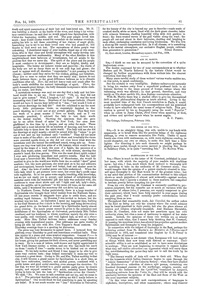
Sir,—It is an almighty thing, this will, usable to rap heads with apparently, or to break them like the precious balms of the righteous perhaps, or even to remove mountains like Faith. Usable to mend hearts also riven with restlessness, or, with more righteous rending, to mould character, our own or others, to make this dark time a little lighter. For directing it into such channels we might perhaps be slightly more useful, though we never succeed in planting Ben Nevis in Salisbury Plain, or in quite “unveiling Isis.”

No Matter Who.

Spiritualism in the East

Sir,—There is much in the letter of M. Constant, published in your last issue, with which the majority of your readers will doubtless agree; but also, I fear, much which those inclined to theosophy will be unwilling to take on the authority of M. Constant alone. One would imagine that the opinion of a person similarly situated to himself upon theosophy in the East would be of the greatest value; but to my mind that portion of his communication devoted to this subject shows so much prejudice—I almost said animosity—against modern theosophers, that I (merely a student in these matters) feel compelled to hesitate greatly before accepting his ipse dixit.

From his own showing, M. Constant is eminently qualified to pronounce judgment, but his remarks are so much at variance with the statements of others (who, I presume, are equally competent to give their opinions), which have been fully reported in your pages during the past year, that I would certainly prefer corroboration before accepting them as true.

Throughout that remarkable work, Isis Unveiled, the author refers to the East as being not only the country where the occult sciences may be found practised in their purity, but also the place whence all science and religion originally emanated. And Madame Blavatsky, unlike M. Constant, does not make her assertions upon her own authority alone, but cites a mass of testimony in support of her statements. Indeed, the opinions of these two writers are so utterly opposed to each other, that I cannot help thinking that M. Constaut, in penning his merciless letter, has allowed his prejudice against modern Spiritualism and theosophy to warp his judgment.

In connection with the subject of theosophy in the East, perhaps the following extract from St. Martin’s Le Ministere de l’Homme-esprit (published in 1802, and translated into English by E. B. Penny in 1864) may be of interest:—

“Perhaps the time is not distant when Europeans will look eagerly at things which they now treat with distrust or contempt. Their scientific edifice is not so established as not to have some revolutions to undergo. They are now beginning to recognise in organic bodies what they call elective attraction—an expression which will carry them far, notwithstanding the pains they take not to call the truth by its right name.

“The literary wealth of Asia will come to their aid. When they see the treasures which Indian literature begins to open through the “ Asiatic Researches ” of the Calcutta Society; when they have studied the Mahabarat—a collection of sixteen epic poems, containing one hundred thousand stanzas on the mythology, religion, morals, and history of the Indians—and the Upnek’hat, translated by Anquetil, containing extracts from the Vedas, &c , they will be struck with the similarity between the opinions of the East and those of the West on the most important subjects.

“In this mine some will seek correspondences of languages in alphabets, inscriptions, and other monuments; others may discover <... continues on page 8-150 >


Editor's notes

  1. The Theosophists in Bombay by unknown author, Bombay Gazette, The, Tuesday, March 25, 1879
  2. We beg to remind... by unknown author, Indian Spectator, The, March 23, 1879
  3. The Power of the Will by unknown author, London Spiritualist, No. 338, February 14, 1879, p. 81
  4. Spiritualism in the East by unknown author, London Spiritualist, No. 338, February 14, 1879, pp. 81-2


Sources