
 |
vol. title: vol. period: 1881 pages in vol.: 439 |
A Word with Our Friends
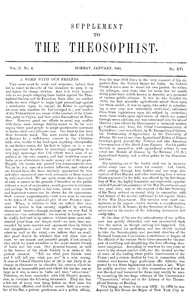
That cause must be weak and desperate, indeed, that has to resort to the arts of the slanderer to prop it up and injure its chosen victims. And it is truly lamentable to see people adopting these tactics against the Theosophical Society and its Founders. Soon after we reached India we were obliged to begin legal proceedings against a missionary organ, to compel its Editor to apologize for some base slander he had indulged in; and readers of the Theosophist are aware of the conduct of the Christian party in Ceylon, and their utter discomfiture at Panadure. However great our efforts to avoid any conflict with them, some strange fatality seems to be for ever urging these good people to adopt questionable measures to hasten their own ultimate ruin. Our Society has been their favourite mark. The most recent shot was fired at Benares by a well-known convert to the Christian faith, who, unable to lay hold upon anything disreputable in our Indian career, did his best to injure us in a certain important direction by sneeringly suggesting to a very high personage that Col. Olcott was a man of no position in his own country, and had doubtless come to India as an adventurer, to make money out of the people. Happily his venom was poured into unsympathetic ears. Yet, as he is a man of a certain influence, and others of our friends have also been similarly approached by him and other enemies of ours, such calumnies as these cannot be well overlooked. We are quite aware that a document of such a nature as the present, if launched upon the public without a word of explanation, would give rise to criticism, and perhaps be thought in bad taste, unless very serious and important reasons can be shown for its appearance. Such reasons unquestionably exist, even were no account to be taken of the malicious plot of our Benares opponent. When, in addition to this, we reflect, that ever since we landed in this country, impelled by motives, sincere and honest,—though, perhaps, as we now find it ourselves, too enthusiastic, too unusual in foreigners to be readily believed in by natives, without some more substantial proof than our simple word—we have been surrounded by more enemies and opponents than by friends and sympathizers; and that we are two strangers to rulers as well as the ruled,—we believe that no available proof should be withheld that will show that at least, we are honest and peaceful people, if not actually that which we know ourselves to be—most sincere friends of India and her sons. Our personal honour, as well as the honour of the whole Society is at stake at the present moment. “Tell me what your friends were and I will tell you what you are” is a wise saying. A man at Colonel Olcott’s time of life is not likely to so change in character as to abandon his Country where he has such an honourable past and where his income was so large as it was, to come to India and turn “adventurer.” Therefore, we have concluded, with Col. Olcott’s permission, to circulate the following documents. They are but a few out of many now lying before us, that show his honourable, efficient, and faithful career, both as a member of the Bar, a private gentleman, and a public official, from the year 1852 down to the very moment of his departure from the United States for India. As Colonel Olcott is not a man to sound his own praises, the writer, his colleague, may state that his name has for nearly thirty years been widely known in America as a promoter of various public reforms. It was he who founded (in 1858) the first scientific agricultural school there upon the Swiss model; it was he again, who aided in introducing a new crop now universally cultivated; addressed three State legislatures upon the subject by invitation; wrote three works upon agriculture, of which one passed through seven editions, and was introduced into the school libraries; was offered by Government a botanical mission to Madagascar, and, later, the Chief Commissionership of Agriculture; and was offered, by Mr. Evangelides of Greece, the Professorship of Agriculture in the University of Athens. He was at one time Agricultural Editor of Horace Greeley’s great journal, the Tribune, and also American Correspondent of the Mark Lane Express. For his public services in connection with agricultural reform he was awarded two Medals of Honour by the National (U.S.) Agricultural Society, and a silver goblet by the American Institute.
The breaking out of the fearful civil war in America called every man to serve his country. Col. Olcott, after passing through four battles and one siege (the capture of Fort Macon), and after recovering from a severe illness contracted in the field, was offered by the late Secretary of war, the highly honourable and responsible appointment of Special Commissioner of the War Department; and two years later, was at the request of the late Secretary of the Navy ordered on special duty in connection with that branch of the service, additional to his regular duties in the War Department. His services were most conspicuous, as his papers—which include a complimentary report to the U.S. Senate, by the Secretary of the Navy—prove and as the reader of the following documents will easily infer.
At the close of the war the national army of one million men was quietly disbanded, and was reabsorbed back into the nation as though nothing had happened. Col. Olcott resumed his profession, and was shortly invited to take the Secretaryship and practical direction of the National Insurance Convention, a conference or league of the officials of the various State Governments for the purpose of codifying and simplifying the laws affecting insurance companies. Accepting, he was thus for two years or more in the closest contact with, and the trusted adviser of, some of the leading State public functionaries of the Union; and a statute drafted by him, in connection with another well-known legal gentleman (Mr. Abbott), was passed by ten State legislatures and became a law. What his public services were in this connection, and how he was thanked and honoured for them, may readily be seen by consulting the two large volumes of the Convention’s “Transactions,” which are in the Library of the Theosophical Society, at Bombay.
This brings us down to the year 1872. In 1876 he was deputed by His Honor the Mayor of New York City to <... continues on page 11-26 >
Editor's notes
- ↑ A Word with Our Friends by Blavatsky, H.P., Supplement to The Theosophist, v. 2, No. 4, January, 1881, pp. 1-2
Sources
-
Supplement to the Theosophist, v. 2, No. 4, January, 1881, pp. 1-2