
 |
vol. title: vol. period: 1881 pages in vol.: 439 |
The Great Pyramid of Cheops
Over the “King’s Chamber” are seven other chambers above each other, the first of which is entered by an aperture 28 inches square; and twice in the year the sun seemed as if seated on its very apex.
With our author and his authorities, every stone and inch in the building has its prophetical tongue; it is a “Stone Bible.” The lowness of the passages indicates humility, the descending passage to the dark pit typifies the easy descent into sin, and its gloomy appearance; the ascending passage typfies regeneration. He finds therein the Patriarchal, Jewish, and Christian dispensation. Here we may observe that the ancient mysteries, in their first grade, had a gloomy descent which typified the descent into Hades, as Apulieus records. The three dispensations are the three grades of these mysteries; in the first was taught the doctrine of the dyad, or the dual principles of good and evil; in the second, Sabeism, or the doctrine of the natural forces; in the third degree Jahoism, or the subjection of these to a sole deity.
The great difficulty with all exoteric writers on the Pyramid question is to find a use for the building. They ask why there are no sepulchral remains, or when was it closed to profane curiosity? At Cheops’ death was the nation so disgusted with his worthless building that they refused to inter his body there and closed it? Was it a specimen pyramid and for mystical purposes? We are inclined to think that these buildings marked, in some respect, a change of faith from the old Coptic worship to. that of the Samancans and Gymnosophists of Ethiopia and India. What is now known of the interior occupies a very small proportion of the structure, and there may even be within it a labyrinth of undiscovered rooms.
It is relatively placed as the physical and metaphysical centre of the earth. If a line be drawn from the North to the South Pole, it will pass over more dry land suitable for habitation than any other spot; it is, therefore, the very best position for the centre of the Mystic Temple of all nations. The author of “Isis Unveiled” (H. P. Blavatsky), shows that there are reasons to believe that the Great Pyramid, the Nagon Wat of Cambodia, the Teocallis of Cholula, were built by priests of one and the same identical faith, even if they had no communication for ages, for the necessities of their religion are identical. All these structures correspond with the “Sacred Precinct” of the Himavat, the highest peak of the Hymalayas, and all and each to a certain multiple of their parts to form the polar diameter.
There does not seem to be any great amount of Craft Masonic symbolism in this very ancient building, but it may have been developed in the period of the successors of the infamous Cambyses, for the recent discoveries by Com. Gorringe at the base of Cleopatra’s Needle indicates that the priestly architects made use of the same emblems as Modern Craft Masons. Hence it is probable that at this early period there was a Craft Masonry and a High Grade Masonry running side by side, but distinct from each other, though having a common origin. It may be that after the overthrow of the Egyptian power, the pyramid was closed with the destruction of the Priesthood, who were dispersed and dethroned from their high estate. Our ceremonies inform us that the Rites became dwarfed to societies of Essenes and Christians.
<... continues on page 11-256 >
Editor's notes
- ↑ The Great Pyramid of Cheops by Yarker, John, Ill.Bro.33◦-96◦, Kneph, v. 1, No. 10, October 1, 1881, pp. 73-4
Sources
-
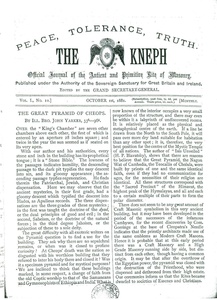
Kneph, v. 1, No. 10, October 1, 1881, pp. 73-4