
 |
vol. title: vol. period: 1881 pages in vol.: 439 |
Credulity
There is a fascination in immensity. The Great Eastern steamship obscuring half the town of Milford from view, the Sphinx in colossal grandeur rising in the starlit desert, the Albert Hall resembling a gasometer of a size seen only under the influence of nightmare, strike the beholder with awe. The “cloud-capped towers and gorgeous palaces,” the mighty Himalayahs and their wonderful “Brothers,” the fathomless waters of the boundless ocean, all impress man with the sentiment of his utter insignificance in the scale of creation. The great globe itself “in heaven’s dark hall, high up the crowd of worlds,” is overpowering in its vastness, so are the suns and constellations whose light takes years to travel to us through the infinite silence of interstellar space. But what are these to the boundlessness of the infinite ocean of human credulity, an ocean without a shore, an ocean to the depths of which no ray of moral or intellectual light has ever penetrated?
Of this credulity a section may be found inside Spiritualism, represented by those persons who promptly recognise handkerchiefs presented at cabinet windows in a dim light, as the faces of their grandfathers and grandmothers, and who grow angry with any other enthusiasts present who are too quick for them, and claim the dear defunct before they have had time to do the same. Sometimes they “run” a particular medium. If any fine morning one of these enthusiasts were to hear his favourite medium say: “Look! The sun is as black as a coal to-day I” he would gaze at it for a minute with beaming eyes and placidly reply, “So it is; I never noticed that before.”
Swindling and imposture flourish under the auspices of credulous enthusiasts who are impenetrable to evidence. In America no swindle, however atrocious, has ever been perpetrated by mediums without the latter being defended by a knot of simple-minded people. In one case in which a trap-door through the floor and elaborate machinery were found, and in which the accomplices made a full confession of how they had acted as spirits, and told some of the enthusiasts the private remarks they, while dressed as ghosts, had whispered, and the tests they had given, were the credulous convinced? Not they.
To these people, common-place utterances, when given by abnormal means, are “religious revelations from the angel world,” and a medium, however vulgar and untruthful, is an inspired prophet. They do more mischief to Spiritualism than the worst of its declared adversaries, by thrusting their own mental weakness and the worthlessness of their opinions before the public, and the public sometimes judges of Spiritualists at large by these prominent samples. How to deal with them is one of the most difficult problems the movement could take in hand to practically solve.
The Himalayan Brothers
Sir,—I have noticed with much regret in some recent numbers, the tone of your remarks about “Occultism,” “Theosophy” and the “Brothers;” but not desiring to enter into controversy, if avoidable, I have refrained hitherto from commenting on, or answering the unfavourable criticisms. However, the mention of my name in your last issue leaves me no other alternative than to enter the arena and defend as far as in me lies, the society of which I am a lowly member, and the “Brothers” whom I believe in and reverence. It is a pity you should, in so great a degree, take up the attitude of the sceptical world towards Spiritualism, when treating of the Theosophical Society and its founders. With so broad a platform to stand on as the acceptation of the phenomena, Spiritualists and Theosophists need not even jostle, much less try to push each other off. Having thoroughly investigated these phenomena and become convinced of their truth, I was, in default of any other explanations of their origin, inclined to accept those given by Spiritualists. I consider those explanations very natural ones, falling in as they do with preconceived beliefs, and supplying an apparently rational cause. But if we reflect we shall see that the very fact that these theories coincide with our preconceived ideas, is really an argument against their being the true ones, as there would be a natural tendency to accept too readily, and on insufficient data any theory which fell in with easily conceived possibilities or probabilities. That all those who have long, with unbiassed minds, investigated these phenomena, become dissatisfied with the accepted theory of causes, points to difficulties and contradictions not seen on a short acquaintance with the subject. If then we hear that the true theory of these wonders and a reasonable philosophy of the Universe may be learned, should we not be wrong in refusing to inquire of those who, we are told, can instruct us? and is it not unbecoming in the few who have stepped out from amongst the many to defend an unpopular truth, to assume an attitude of sneering incredulity, when some of their ranks go still further in the path of inquiry? The same candour and courage which have enabled Spiritualists to stand up against the ridicule of the world and declare their convictions, should also lead them to inquire into fresh evidence, if forthcoming, on these subjects. Is it to be supposed that with the utter ignorance prevailing on all matters occult, a few years should have taught us all there is to learn in connection with these phenomena? Believing then, and with good reason, that an ancient order exists which is able and willing to give some knowledge to the world on occult matters, a society is formed, and we sit at the feet of the “Brothers” to learn. When such men as Mr. Hume and Mr. Sinnett are its leading members it can scarcely be supposed by reasonable people that our “Brothers” are quite the mythical persons some of our critics would infer. Now let me answer the few questions you ask in the paper of August the 19th, for as you say the evidence of Col. Gordon and myself would carry great weight, we are bound to give it. You ask whether the natives who signed the letter declaring they had seen and conversed with an adept are in the same position as yourself, who has been visited by one who said he was an adept. Certainly not; those witnesses had proof that the person they saw was an adept. You ask whether the lives of these men are such as on the given theory to account for their seeing the “Brothers.” Yes, they are men who are devoting themselves entirely to the work of the Theosophical Society, and they are water drinkers and vegetarians. Col. Olcott has seen several of the “Brothers,” and I know of no other European on this side of the water except Madame Blavatsky, who could reasonably hope to have the privilege, as yet. Still, we who have been with Madame Blavatsky a good deal have had satisfactory proof of their existence and of their power, and a volume of correspondence is accumulating from Koot Hoomi Lal Sing. I have seen a letter arrive from him by occult means in broad daylight, and so have other Theosophists. We are allowed to consider him as the patron of our Branch Society, just formed for Anglo- Indians. Although I cannot now subscribe myself a Spiritualist in the ordinary acceptation of the term, I am not likely to abuse the ladder by which I mounted, for without my knowledge of the marvellous phenomena of Spiritualism, I could never have been in a position to accept anything I may now learn. But it is not altogether pleasant to step out again into uncertainty, when one had formed a comfortable cut and dry philosophy ready to hand, and were one free to choose, one might be tempted to accept the ignorance which is bliss, rather than seek further knowledge. In these matters I think we are not free, our minds will work on, and the same restless spirit of inquiry which first led us from the faith of our childhood, still asserts itself. Before closing this let me advise, any Spiritualist who wishes to know some of the theories we are learning about the phenomena, to get the October number of The Theosophist. I have just had the pleasure of reading the MS. of a very able article on the subject, and it answers some of the most pertinent questions which are asked by those who have accepted the Spiritualistic theories.
Rothney Castle, Simla, September 15th.
Courses or Ex-votos
Sir,—In Mrs. Showers’ letter, she gives, on the authority of her dictionary, the meaning of the word anathema to be an offering set or hung up “in a temple devoted to the gods.”
My dictionary (Littleton, Latin Dictionary, 4to, London, 1723) gives also the same meaning for the word anathema. But it recognises the more frequent word anathema, as signifying “a curse,” and gives the derivation of the verb used “to curse” (anathematigo) from this noun. Of course it could not be from the other one.
May I suggest that the resemblance in spelling, though not in pronunciation, or meaning, has led to a confusion that vitiates some of the argument?
Editor's notes
Sources
-
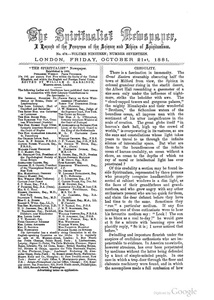
London Spiritualist, No. 478, October 21, 1881, pp. 193-94
-

London Spiritualist, No. 478, October 21, 1881, pp. 197-98
-

London Spiritualist, No. 478, October 21, 1881, p. 202